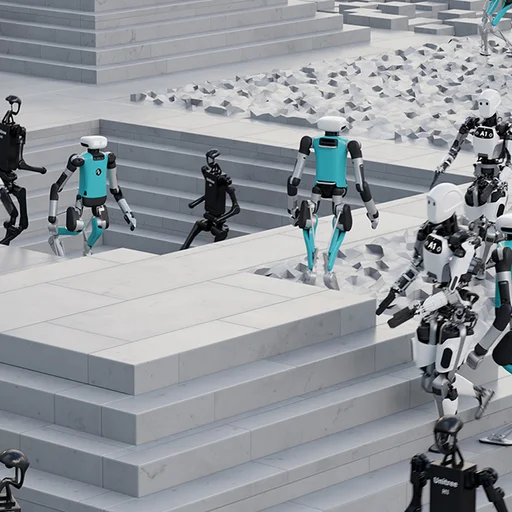
NVIDIA Isaac Sim
GPU-accelerated robotics simulator for building, testing, and training robots in OpenUSD-based virtual environments. It supports ROS 2, MJCF and URDF import, synthetic data generation, and digital twin workflows.
NVIDIA Isaac Sim is a GPU-accelerated robotics simulation platform built on NVIDIA Omniverse and OpenUSD. It is used to import robot models, build physically based virtual scenes, simulate sensors, generate synthetic data, and test robot software before deployment on real hardware.
What it does
Isaac Sim combines physics simulation, RTX sensor rendering, and OpenUSD scene composition in one environment. Teams can import robots from URDF, MJCF, CAD, and related formats, connect them to ROS 2 workflows, and run reinforcement learning, perception, and digital twin experiments against the same simulated assets.
How it fits into robotics workflows
The platform is strongest in simulation-first robotics pipelines. NVIDIA documents integrations for ROS 2, MoveIt 2, Isaac Lab, and synthetic data generation, which makes Isaac Sim useful for manipulation, navigation, warehouse automation, and industrial facility modeling. Its OpenUSD foundation also makes it suitable for teams that need to move assets between design, simulation, and downstream validation workflows.
Deployment and developer experience
Isaac Sim can run as a workstation application or as a Linux container for headless and cloud-hosted deployment. The source repository exposes Python and C++ development workflows, while the documentation covers Docker, NVIDIA Container Toolkit, WebRTC streaming, MJCF import, and hardware-in-the-loop scenarios through ROS 2.
Limitations
- Isaac Sim has high hardware requirements, with NVIDIA documenting an RTX 4080-class GPU and 32 GB RAM as the minimum x86_64 baseline for current releases.
- Linux container deployment is supported, but the container workflow depends on Docker, NVIDIA Container Toolkit, and host networking for livestreaming, which adds operational overhead compared with lighter simulators.
- Some workflows and tutorials depend on online assets, cloud connectivity, or separate Omniverse and Nucleus components, so fully isolated environments need extra planning.
- Importing MJCF into USD is not lossless in every case; the documentation calls out joint-model differences that can require dummy links or post-import adjustment.
- Although the codebase is published under Apache-2.0, NVIDIA also documents separate licensing conditions around Omniverse Kit redistribution and some bundled materials.
NVIDIA Isaac Sim MoveIt
Isaac Sim documents a MoveIt 2 workflow over ROS 2 for manipulation planning and execution in RViz using the bundled isaac_moveit packages.
NVIDIA Isaac Sim MuJoCo
Isaac Sim can import MJCF assets from MuJoCo workflows and convert them to USD, making MuJoCo models reusable inside Isaac Sim. This is a one-way asset import path, so MuJoCo-authored robots and environments can be brought into Isaac Sim simulations even though the two simulators use different joint representations.
NVIDIA Isaac SimNVIDIA Isaac Lab is the robot learning framework that uses Isaac Sim environments for reinforcement learning, policy training, and validation. Isaac Sim provides the simulation backend, while Isaac Lab provides the RL training layer on top of it.
- Kind
- Software
- License
- Open Source
- Website
- developer.nvidia.com ↗

Similar to NVIDIA Isaac Sim

