PackML MQTT Simulator
Open-source manufacturing line simulator for PackML messaging over MQTT. It emulates PackML state transitions, commands, counters, and machine-speed telemetry for testing industrial data pipelines and SCADA integrations.
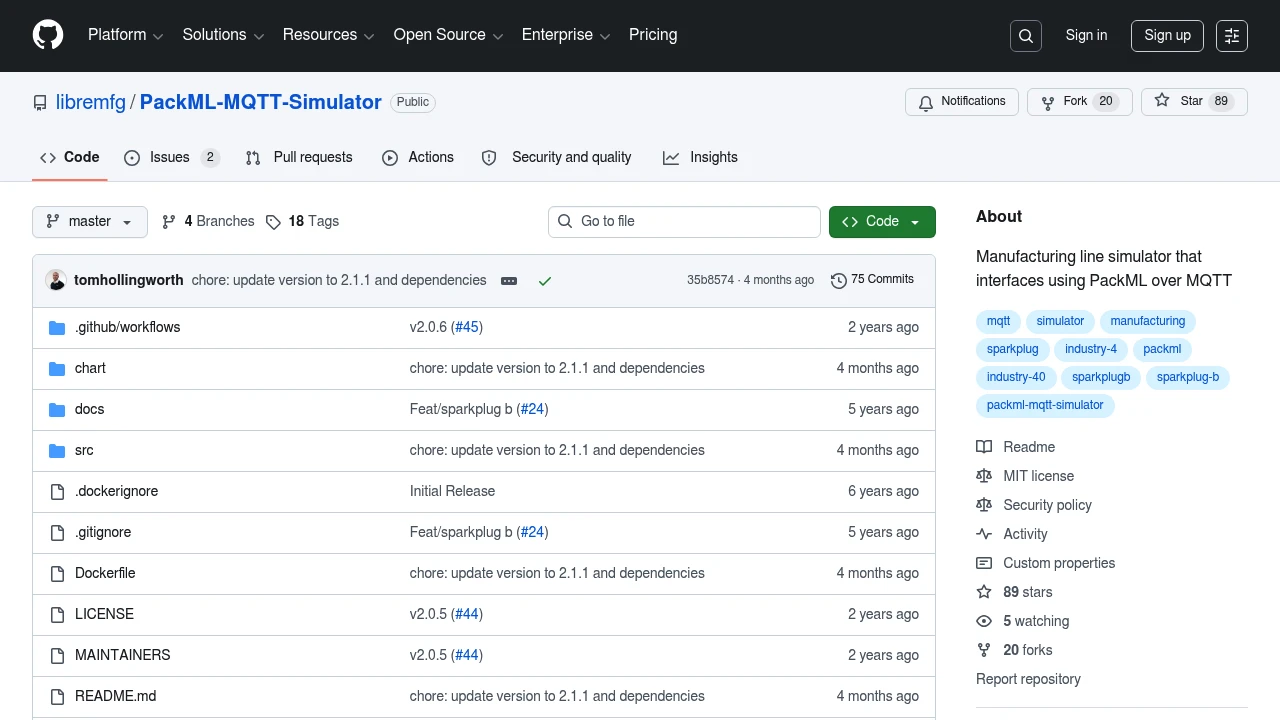
PackML MQTT Simulator is an open-source manufacturing line simulator for teams that need realistic PackML telemetry without connecting to a physical machine. It emulates PackML state transitions, unit modes, counters, machine speed, and command handling over MQTT, with optional Sparkplug B payload support for testing dashboards, brokers, UNS pipelines, and SCADA connectors.
What it does
The simulator models a virtual production line that starts in clearing and stopped states, then responds to PackML commands such as reset, start, stop, hold, unhold, complete, and abort. It publishes status and admin data on MQTT topics, including current state, unit mode, speed setpoints, produced and defective counts, and parameter echoes. For Sparkplug B setups, it can publish and receive device and node command messages using the Sparkplug namespace.
How it is deployed
PackML MQTT Simulator can run as a Docker container, a Node.js process, or as part of a larger Docker Compose setup that simulates multiple production lines. Configuration is done through environment variables such as SITE, AREA, LINE, MQTT_URL, MQTT_PORT, CLIENT_TYPE, and Sparkplug identifiers, which lets teams map the simulator into ISA-95-style topic structures and test both simple MQTT and Sparkplug B flows.
Where it fits
This tool fits best in simulation and test environments rather than in production control stacks. It is useful when validating MQTT topic design, PackML state handling, UNS ingestion, historian pipelines, or SCADA projects before field deployment. The UMH Classic documentation also describes it as a community-contributed microservice enabled by default, and the project README includes a Sparkplug B example for Ignition.
Limitations
- It simulates PackML behavior but does not control or emulate vendor-specific PLC execution logic, fieldbus timing, or hardware faults, so it cannot replace hardware-in-the-loop validation.
- The project depends on an external MQTT broker and environment-variable configuration, which means it does not provide a built-in broker, management UI, or turnkey test harness by itself.
- Its public footprint is relatively small, with a niche maintainer base and limited ecosystem documentation compared with broader industrial platforms such as Ignition or United Manufacturing Hub.
- The implementation focuses on MQTT and Sparkplug B messaging, so teams that need OPC-UA, Modbus, or direct PLC protocol simulation need additional tools around it.
PackML MQTT Simulator Ignition by Inductive Automation
The project README includes a Sparkplug B example showing PackML MQTT Simulator publishing into Ignition with Cirrus Link MQTT modules.
PackML MQTT Simulator United Manufacturing Hub
PackML MQTT Simulator is documented by UMH Classic as a community-contributed microservice enabled by default for testing PackML-over-MQTT data flows inside the United Manufacturing Hub stack.
- Kind
- Software
- License
- Open Source
- Website
- github.com ↗

Similar to PackML MQTT Simulator