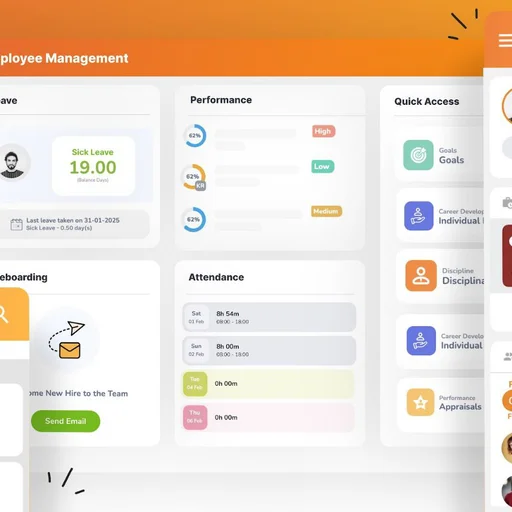
 OrangeHRM
 Workday
OrangeHRM and Workday both provide comprehensive HR management solutions, but target different market segments. OrangeHRM offers a free open-source Starter edition ideal for small businesses, while Workday focuses on enterprise-scale organizations with advanced analytics and global payroll capabilities.
 Kanboard
 Redmine
Kanboard and Redmine both serve self-hosted project tracking, but Kanboard centers on a simple kanban board while Redmine is a broader project and issue management application with wikis, Gantt charts, and deeper administrative features.
 Chatwoot
 Salesforce
Chatwoot can sync contacts and conversations with Salesforce CRM.
Chatwoot Intercom
Chatwoot and Intercom both provide customer support platforms with live chat and messaging capabilities.
Chatwoot Slack
SlackChatwoot integrates with Slack to route conversations and notify team members.
 Open QuarterMaster
Open QuarterMaster and Part-DB are both open-source inventory management systems for self-hosted environments. Open QuarterMaster emphasizes a modular core API plus plugin model for broader inventory workflows, while Part-DB is more specialized around component inventory and electronics use cases.
 LedgerSMB
 Odoo
OdooLedgerSMB and Odoo Community Edition compete in the open-source ERP space. LedgerSMB provides focused accounting/ERP functionality without module bloat, while Odoo offers an extensive app ecosystem.
LedgerSMB ERPNext
LedgerSMB and ERPNext are both open-source ERP solutions for SMBs. LedgerSMB focuses on accounting-first with Perl/PostgreSQL stack, while ERPNext offers broader CRM/HR features on Python/MariaDB.
Redmine OpenProject
Redmine and OpenProject are both open-source project management tools built on Ruby. Redmine is the original project (launched 2006) while OpenProject forked from Redmine in 2011 to pursue a different development philosophy.
OpenProject Microsoft SharePoint
OpenProject integrates with Microsoft SharePoint for file management and document collaboration. Enterprise users can link files and folders with work packages and set up automatic project folder synchronization.
 InvenTreeERPNext
InvenTree can integrate with ERPNext via REST API to connect inventory management with broader business processes like accounting, CRM, and procurement.
InvenTreeInvenTree and Part-DB are both open-source inventory management systems for tracking parts and components. InvenTree offers broader inventory management with BOM and build tracking, while Part-DB specializes in electronic components with deep KiCad EDA integration.
 Docker MCP Gateway
 ContextForge
Both tools centralize MCP server access behind a gateway layer, but ContextForge extends beyond containerized MCP routing into registry, A2A, REST/gRPC translation, and built-in observability. Docker MCP Gateway is the lighter-weight option for Docker-centric MCP aggregation, while ContextForge targets broader agent platform control planes.
 Lasso GatewayDocker MCP Gateway
Docker MCP Gateway and Lasso Gateway target teams deploying MCP gateways, but Docker leads with container isolation and local runtime management while Lasso Gateway is positioned more heavily around governance and security controls for regulated environments.
 Augmentir
 Poka
PokaAugmentir and Poka both provide connected worker platforms for manufacturing, focusing on digitizing work instructions and empowering frontline workers with mobile-first solutions.
Augmentir Tulip
TulipAugmentir and Tulip both serve the connected worker market in manufacturing, but with different architectural approaches. Augmentir emphasizes AI-powered adaptive guidance and augmented reality for remote assistance. Tulip focuses on no-code app building and composable MES with broader platform extensibility.
 Samsara
 Geotab
Samsara and Geotab are both shortlisted for fleet telematics, compliance, routing, and connected operations visibility. Samsara's own comparison source identifies Geotab as a major fleet management technology provider in the same buying set.
 Tableau
 Grafana
Tableau integrates with Grafana for unified observability and business intelligence. Tableau handles business analytics while Grafana monitors infrastructure and application metrics.
SlackMicrosoft SharePointSlack integrates with Microsoft SharePoint through the marketplace OneDrive and SharePoint app so teams can share files and document links inside conversations. This makes SharePoint content accessible in Slack without treating Slack as the document system of record.
SlackSalesforceSlack integrates with Salesforce so account, case, lead, and opportunity context can appear inside team channels and workflows. Slack's pricing and product pages position Salesforce data and follow-up work as a native CRM workflow inside Slack.
 NVIDIA Isaac Sim
 MoveIt
Isaac Sim documents a MoveIt 2 workflow over ROS 2 for manipulation planning and execution in RViz using the bundled isaac_moveit packages.
 MuJoCo
MuJoCo complements Gazebo through model-conversion workflows such as gz-mujoco, which translates between SDFormat and MJCF for robotics simulation stacks using both ecosystems.
 Nav2
Nav2 Foxglove
Nav2 can be monitored and debugged using Foxglove's modern robotics visualization platform as an alternative to RViz, providing web-based access to navigation data and diagnostics.
Nav2MoveItNav2 handles mobile robot navigation while MoveIt handles robotic arm motion planning. Together they enable complete mobile manipulation systems where robots navigate to objects and manipulate them.
Nav2Nav2 integrates with Gazebo for physics-based simulation and testing of navigation behaviors before deployment to physical robots.
 Onshape
 Siemens Teamcenter
Onshape supports data exchange with enterprise PLM systems including Siemens Teamcenter through standard CAD file formats and API integrations.
Onshape FreeCAD
Both Onshape and FreeCAD provide parametric 3D CAD modeling. Onshape is cloud-native with built-in collaboration while FreeCAD is open-source and desktop-based.
Onshape PTC Windchill
Onshape Enterprise includes native connection to Arena PLM for extended product lifecycle management capabilities
 Qualio
 MasterControl
Qualio and MasterControl compete in the life sciences eQMS market. Both offer FDA-compliant quality management, with MasterControl targeting larger enterprises and Qualio emphasizing rapid deployment for growing companies.
 AVEVA Edge
 Rapid SCADA
Commercial vs open-source HMI/SCADA platforms for industrial automation.
AVEVA Edge Ignition by Inductive Automation
Cross-platform HMI/SCADA development environments for industrial automation.
 ONNX Runtime
 TensorFlow
ONNX Runtime supports TensorFlow models converted to ONNX format through the tf2onnx converter. This enables TensorFlow-trained models to leverage ONNX Runtime's hardware acceleration and cross-platform deployment capabilities.
ONNX Runtime PyTorch
ONNX Runtime natively supports models exported from PyTorch via the ONNX format. PyTorch models can be converted to ONNX using torch.onnx.export() and then optimized and deployed through ONNX Runtime for production inference across diverse hardware targets.
 OpenVINOONNX Runtime
ONNX Runtime and OpenVINO both optimize and accelerate ML model inference across diverse hardware targets. ONNX Runtime emphasizes cross-platform portability with a unified API across CPUs, GPUs, and edge devices through pluggable execution providers. OpenVINO focuses specifically on Intel hardware optimization with broader model format support beyond ONNX.
OpenVINOPyTorchOpenVINO converts and optimizes PyTorch models for inference on Intel hardware.
OpenVINOTensorFlowOpenVINO converts and optimizes TensorFlow models for inference on Intel hardware.
 Your brand here — Reach plant managers, engineers, and technology leaders evaluating manufacturing tools.