 GLPI
GLPI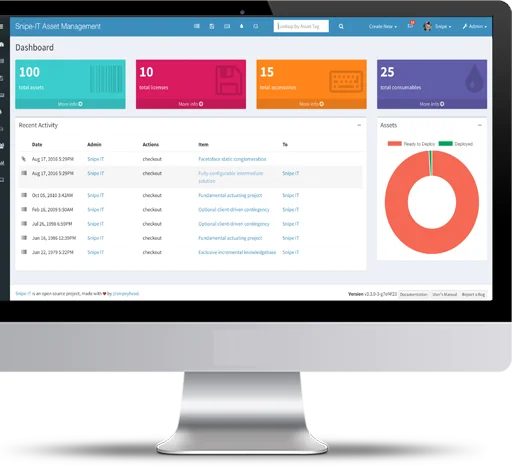 Snipe-IT
Both GLPI and Snipe-IT are open-source IT asset management solutions. GLPI offers broader ITSM capabilities including service desk and CMDB, while Snipe-IT focuses specifically on asset lifecycle management with a more modern UI.
 CVAT
CVAT FiftyOne
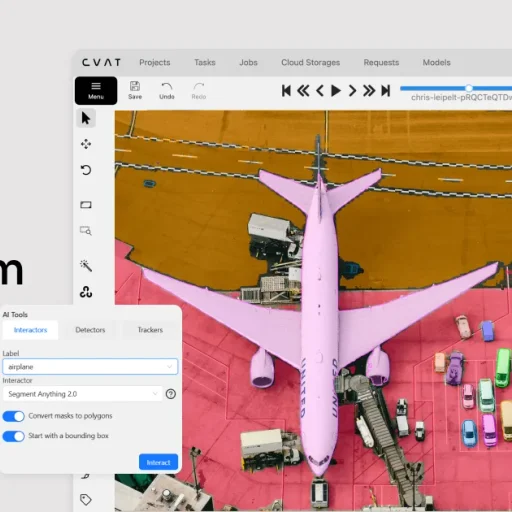
CVAT handles annotation operations, while FiftyOne is used to visualize, inspect, and iterate on computer vision datasets and model results. CVAT documentation states that FiftyOne can create tasks and jobs, upload data, define label schemas, and download annotations programmatically through the integration.
 Webots
Webots and Gazebo are both open-source robotics simulators commonly evaluated for robot development workflows. Phase 0 comparison research positions Webots as easier to learn and Gazebo as stronger in ROS-centric and larger-scale simulation setups.
 BehaviorTree.CPP
 Nav2
Nav2BehaviorTree.CPP provides the behavior tree engine and XML node model used by Nav2 to define navigation, recovery, and task-planning logic, with Groot-based editing documented in Nav2 tutorials.
 MoveIt
Gazebo is commonly used alongside MoveIt to simulate manipulators, sensors, and collision scenes before deploying motion-planning pipelines to real robots.
 CartographerMoveIt
Cartographer provides localization and mapping while MoveIt handles motion planning for robotic manipulation tasks.
CartographerCartographer provides real-world SLAM capabilities that complement Gazebo's simulation environment for robotics development and testing.
 Foxglove
 Grafana
Foxglove and Grafana can be combined for comprehensive robotics observability, with Foxglove handling multimodal robot data and Grafana monitoring infrastructure metrics.
 OctoPrint
 Marlin Firmware
OctoPrint communicates with 3D printers running Marlin firmware via serial USB connection, sending GCODE commands and receiving status updates.
OctoPrint Cura
CuraOctoPrint and Cura form a complete 3D printing workflow. Cura slices STL files into GCODE, which OctoPrint then manages and sends to the printer.
 Onshape
 OpenSCAD
OpenSCAD and Onshape represent fundamentally different approaches to CAD. OpenSCAD uses programmatic scripting for precise mechanical designs while Onshape provides cloud-based graphical parametric modeling with real-time collaboration.
 FreeCAD
 LinuxCNC
FreeCAD's CAM workbench generates G-code that can be executed by LinuxCNC. This integration enables a complete open-source workflow from CAD design to CNC machining.
FreeCADOpenSCADOpenSCAD provides programmatic CAD modeling through code, while FreeCAD offers a full graphical parametric environment. FreeCAD can import OpenSCAD files via its dedicated workbench.
 Greenlight Guru
 Qualio
Both are cloud-based eQMS solutions targeting medical device companies with FDA 21 CFR Part 11 compliance.
 ETQ RelianceQualio
ETQ Reliance and Qualio compete in the life sciences eQMS market. Both offer cloud-based quality management with FDA compliance, but ETQ has broader industry coverage while Qualio emphasizes AI-powered compliance intelligence.
ETQ RelianceGreenlight GuruGreenlight Guru focuses specifically on medical devices while ETQ Reliance serves broader regulated industries including medical devices.
 Ignition by Inductive Automation
 Node-RED
Ignition and Node-RED can exchange data via MQTT, REST APIs, and databases for flexible industrial automation workflows.
Ignition by Inductive Automation InfluxDB
Ignition's Historian module can store time-series data in InfluxDB for high-performance analytics and integration with the MING stack.
Ignition by Inductive Automation Mosquitto
Ignition connects to Mosquitto MQTT broker via the Cirrus Link MQTT modules for IIoT data collection and edge-to-cloud communication.
Ignition by Inductive AutomationGrafanaIgnition's SQL Bridge and Historian modules enable seamless data export to Grafana for advanced visualization and dashboarding.
 Rapid SCADAGrafana
Rapid SCADA can send data to Grafana for advanced visualization and dashboarding.
Rapid SCADAInfluxDBRapid SCADA can archive data to InfluxDB for time-series storage and analysis.
Rapid SCADAMosquittoRapid SCADA integrates with Mosquitto as an MQTT broker for IIoT device communication and data acquisition.
Rapid SCADA ThingsBoard
Rapid SCADA and ThingsBoard compete in the open-source IoT platform and SCADA space, both supporting MQTT and providing visualization capabilities.
Rapid SCADAIgnition by Inductive AutomationRapid SCADA and Ignition both provide industrial SCADA/HMI capabilities with web-based interfaces, though Ignition is commercial while Rapid SCADA is open-source.
 PTC Windchill
Aras Innovator and PTC Windchill are competing enterprise PLM solutions. Aras offers an open-source model while Windchill provides a mature commercial platform with strong IoT and AR integration capabilities.
 Siemens Teamcenter
Aras Innovator and Siemens Teamcenter are both enterprise PLM platforms. Aras offers a unique open-source model with free core software, while Teamcenter is a traditional commercial offering with deep integration into the Siemens ecosystem.
Siemens TeamcenterPTC WindchillPTC Windchill and Siemens Teamcenter are the two dominant enterprise PLM platforms serving large manufacturing organizations with comprehensive product lifecycle management capabilities.
Siemens Teamcenter Siemens Opcenter
Siemens Teamcenter PLM integrates with Siemens Opcenter MES to create a seamless digital thread from engineering to manufacturing. This integration enables bi-directional data flow between product design and shop floor execution.
 Keras
Keras ONNX Runtime
Keras models can be exported to ONNX format for deployment across different inference engines and hardware accelerators. This enables Keras-trained models to run on ONNX Runtime, TensorRT, OpenVINO, and other ONNX-compatible execution providers.
 Doppler
 AWS Secrets Manager
Doppler syncs secrets bidirectionally with AWS Secrets Manager, enabling teams to use Doppler's developer-friendly interface while maintaining compatibility with AWS-native infrastructure.
 JupyterKeras
Keras provides a high-level neural network API that integrates well with Jupyter notebooks for rapid prototyping of deep learning models with immediate feedback and visualization capabilities.
Jupyter TensorFlow
TensorFlow code is commonly developed and debugged in Jupyter notebooks, taking advantage of the interactive environment for iterative model building, training visualization, and experiment tracking.
Keras PyTorch
Keras 3 integrates with PyTorch as one of its three supported backends. When using the PyTorch backend, Keras models use PyTorch tensors and autograd, enabling access to the PyTorch ecosystem including torch.compile, PyTorch Lightning, and native PyTorch deployment options.
KerasTensorFlowKeras 3 integrates with TensorFlow as one of its three supported backends. When using the TensorFlow backend, Keras models compile to TensorFlow operations and can leverage the full TensorFlow ecosystem including TensorBoard, TensorFlow Serving, and TensorFlow Lite for deployment.
 HashiCorp VaultDoppler
Doppler is a developer-focused secrets management platform emphasizing ease of use and rapid onboarding, while HashiCorp Vault targets enterprise infrastructure with extensive customization and policy controls.
 Your brand here — Reach plant managers, engineers, and technology leaders evaluating manufacturing tools.