MetaMCP
Open-source MCP aggregator from metatool-ai that federates upstream MCP servers into namespaced endpoints for MCP clients. Three-level hierarchy of Servers, Namespaces, and Endpoints, with per-endpoint tool ACLs and generic OIDC discovery for admin login.
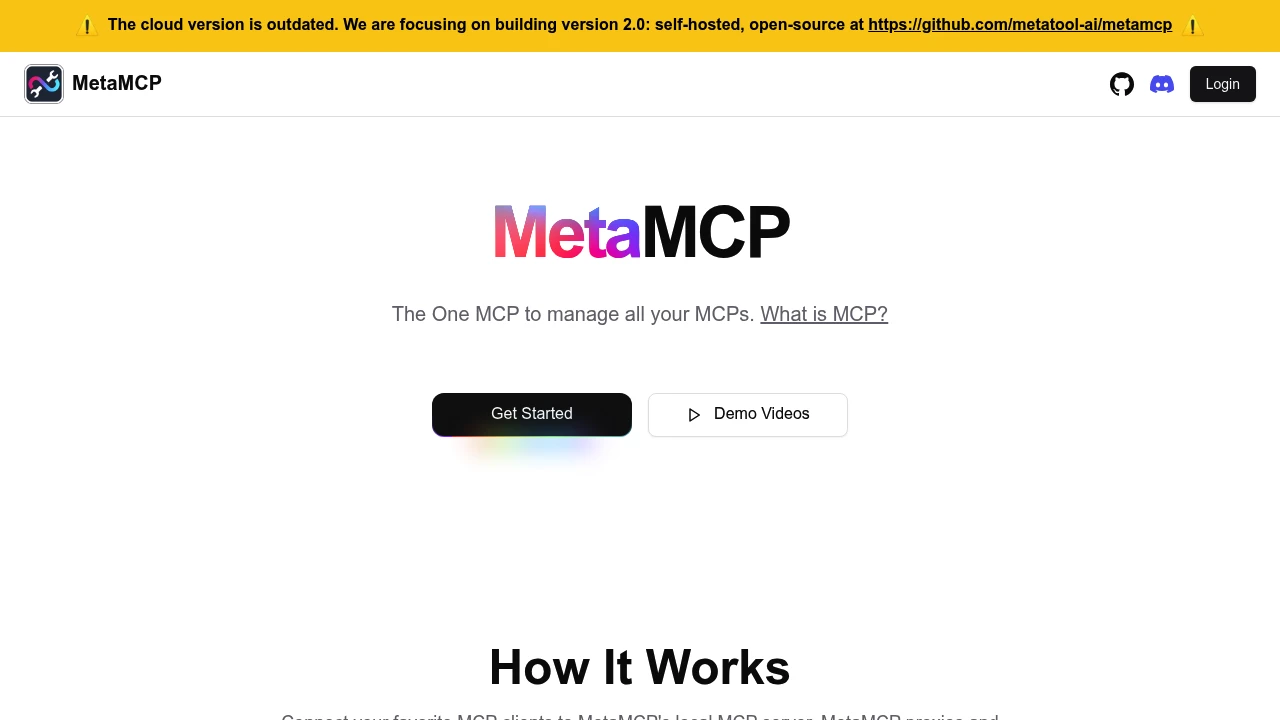
MetaMCP is an open-source MCP aggregator from metatool-ai that federates multiple upstream MCP servers into namespaced endpoints for MCP clients. It organizes tools in a three-level hierarchy — Servers, Namespaces, Endpoints — so operators can compose tool sets and expose them selectively to different clients with different authentication and ACLs.
What it does
Operators register upstream MCP servers across stdio, SSE, and streamable-HTTP transports. Namespaces group servers and their tools into logical bundles, such as a dev-tools bundle, a production-tools bundle, or a customer-support bundle. Endpoints expose namespaces to clients with per-endpoint tool filtering — the same namespace can be published under two endpoints with different allowed tools.
Authentication uses API keys per endpoint, with OIDC discovery supported through the OIDC_DISCOVERY_URL environment variable for admin-UI login against any generic OIDC provider. Credential passthrough lets upstream MCP servers that require their own auth receive credentials transparently.
Licensing
MIT. The full feature set is in the open-source repo; the project is maintained by metatool-ai with community contributions through 2025 and 2026.
Deployment
Docker Compose reference with Postgres and Redis. The admin UI manages servers, namespaces, endpoints, and credentials.
Limitations
- No A2A, REST-to-MCP, or gRPC adaptation — MetaMCP aggregates MCP-to-MCP only.
- Policy model is ACL-based rather than ABAC or policy-language-based; complex conditional access rules require external enforcement.
- Audit is basic request logging without tamper-evident retention.
- Small maintainer team; community is still growing and some integrations and IdP patterns have less public documentation than the larger MCP gateways.
 MCPJungle
MetaMCP and MCPJungle are both lightweight MCP aggregators. MetaMCP has a three-level Servers-Namespaces-Endpoints hierarchy with OIDC discovery; MCPJungle is simpler with API-key-only auth and YAML configuration.
 ContextForge
ContextForge and MetaMCP are both MCP federation gateways. ContextForge is IBM's Apache 2.0 platform with Cedar-based RBAC, 40+ plugins, and a heavier operational footprint; MetaMCP is MIT with a simpler Servers-Namespaces-Endpoints model and lighter deployment.
Similar to MetaMCP