LangChain
LangChain is an open-source Python framework that provides composable building blocks for chaining LLM calls, tools, retrievers, and memory into production AI applications. It includes LangGraph for stateful multi-agent orchestration and 1000+ integrations with model providers and data stores.
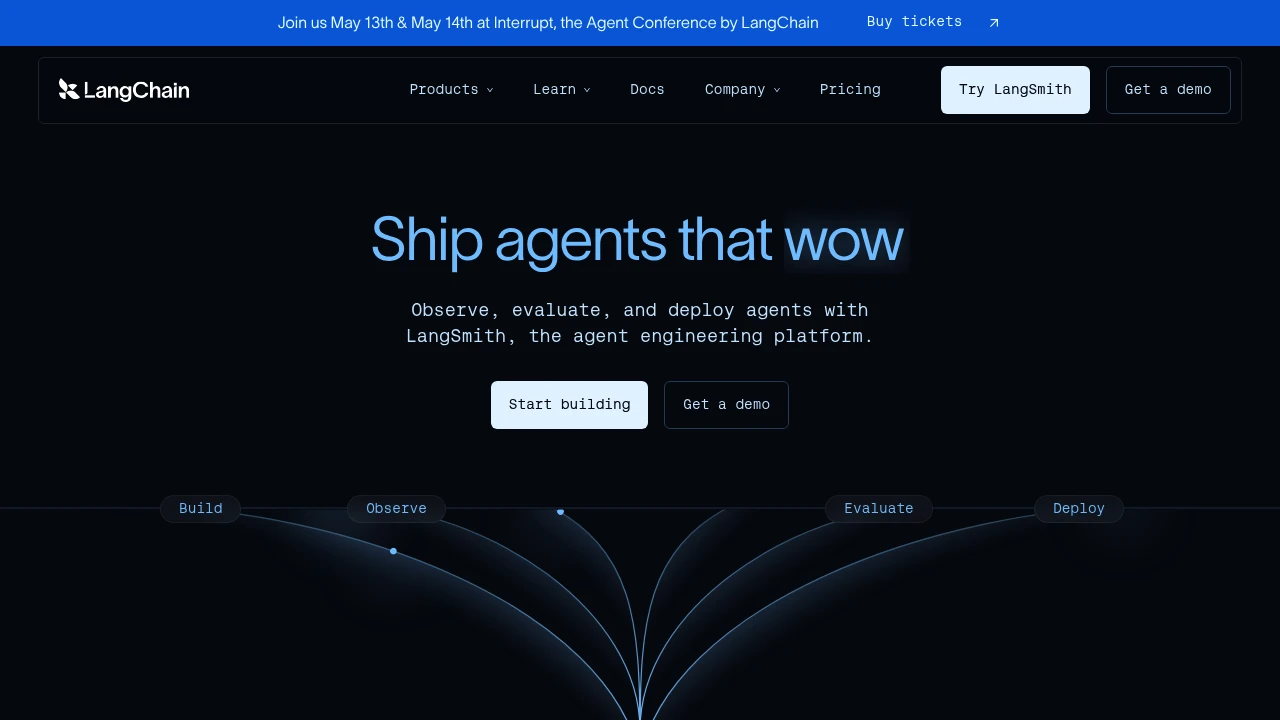
LangChain is an open-source Python framework designed to simplify the development of applications powered by large language models (LLMs). It provides a modular architecture of composable components — including models, prompts, parsers, retrievers, and tools — that developers chain together into sophisticated workflows. The ecosystem includes LangGraph for building stateful, multi-agent systems with cyclic execution graphs, and LangServe for deploying chains as REST APIs.
Originally created by Harrison Chase in October 2022, LangChain has grown into the most widely adopted LLM orchestration framework in the Python ecosystem, with over 130,000 GitHub stars and 3,600+ contributors. It supports 1000+ integrations spanning OpenAI, Anthropic, Google Gemini, local models via Ollama, and dozens of vector stores and document loaders.
In manufacturing and Industry 4.0 contexts, LangChain enables use cases such as natural-language interfaces to MES/ERP systems, RAG-powered maintenance manuals, agent-based supply chain optimization, and conversational analytics dashboards. Its pluggable design lets teams swap model providers or retrievers without rewriting application logic.
Limitations
- Python-centric ecosystem limits adoption in shops standardized on C#, Java, or PLC programming environments.
- Rapid release cadence (daily commits) introduces breaking changes between minor versions, requiring active maintenance.
- Abstraction overhead can obscure performance characteristics, making latency and token-cost optimization harder to reason about compared to direct API calls.
- LangGraph's state-machine model adds conceptual complexity for simple linear chains; teams may over-engineer solutions.
- 1000+ integrations vary widely in quality and maintenance; community-contributed loaders may lack enterprise support or security auditing.
- No native OPC-UA, Modbus, or industrial protocol adapters; shop-floor integration requires custom middleware or separate gateways.
- Memory and state management defaults are in-process; distributed or persistent state requires additional infrastructure (Redis, PostgreSQL).
 LangChain
 TensorFlow
LangChain complements TensorFlow by orchestrating TensorFlow-based models into production pipelines. It handles prompt management, tool calling, and retrieval around TensorFlow-served models without replacing the training framework.
LangChain PyTorch
LangChain complements PyTorch by providing the orchestration layer above PyTorch-based models. Teams train or fine-tune models in PyTorch, then serve them through LangChain chains for RAG, agents, and conversational interfaces.
Similar to LangChain