
LibreChat
Open-source AI chat platform from Danny Avila that mirrors the ChatGPT interface with multi-provider routing, plugins, MCP client, and OpenID Connect login. Docker Compose reference deployment uses MongoDB with optional MeiliSearch for conversation search.
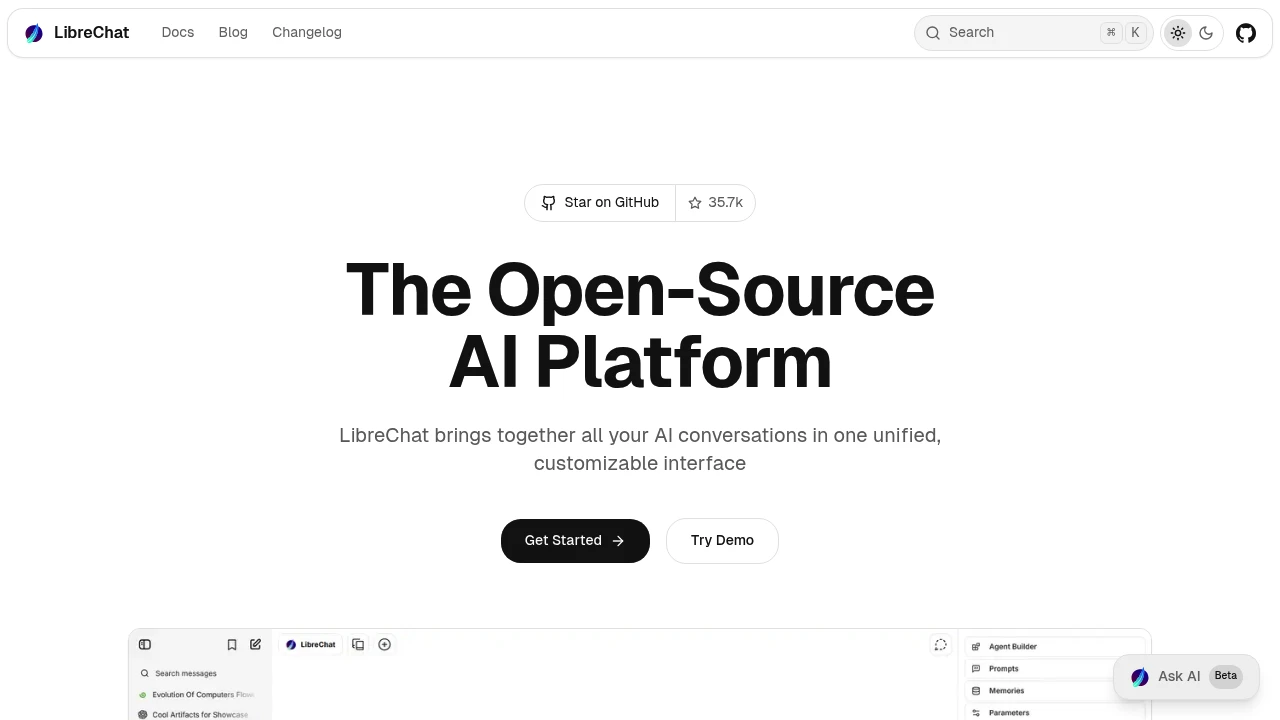
LibreChat is an open-source AI chat platform from Danny Avila that mirrors the ChatGPT interface while adding multi-provider support, plugins, MCP client integration, and multi-user authentication. The project is commonly deployed as a chat front-end to LLM gateways or directly against OpenAI-compatible endpoints.
What it does
Users sign in through a web UI, choose from the providers the admin has configured, and chat. LibreChat supports OpenAI, Anthropic, Gemini, Azure, AWS Bedrock, Mistral, Ollama, and any OpenAI-compatible endpoint. Conversations can be forked and branched — each branch represents an alternative response path — and compared side by side.
File upload supports vision models for image inputs and document RAG for PDF, Word, and text documents. Conversation presets package a system prompt, model, and parameter set together for reuse. Shared prompts let teams publish templates across users.
Authentication covers email-password, OAuth (GitHub, Google, Discord), and generic OpenID Connect. The plugin system provides web search, code execution, and custom tools. MCP client support lets conversations invoke MCP tools inline.
Licensing
MIT. Development runs on a donations-supported community model.
Deployment
Docker Compose reference stack with MongoDB and optional MeiliSearch for conversation search. Runs on Docker, Docker Swarm, and Kubernetes.
Limitations
- MongoDB is the required primary database; there is no Postgres backend, which may not fit stacks standardized on Postgres.
- Admin configuration is driven by environment variables and JSON files rather than an admin UI — most settings are edited on disk.
- Feature scope is chat-UI-first; for programmatic clients like Cursor or Claude Code, LibreChat is not the endpoint — a gateway sits upstream.
- Plugin authoring uses LibreChat's specific plugin format; community plugins exist but the catalog is smaller than hosted alternatives.
 Open WebUILibreChat
Open WebUI and LibreChat are both open-source self-hostable chat UIs with multi-provider support, authentication, and MCP client integration. Open WebUI is BSD-3 with a Pipelines and Functions framework and Postgres backend; LibreChat is MIT with conversation forking, presets, and a MongoDB backend.
 LobeChatLibreChat
LobeChat and LibreChat are both self-hostable AI chat front ends for users who want to connect multiple providers and keep control over deployment. They are natural alternatives for teams comparing open chat UIs with provider flexibility, plugin-style extensions, and optional knowledge features.
 AnythingLLMLibreChat
AnythingLLM and LibreChat both offer self-hostable ChatGPT-style interfaces with multi-provider support, document handling, and MCP or plugin-based extension paths. Teams evaluating an open-source internal AI workspace often compare them as direct substitutes.
Similar to LibreChat

