Datumaro
Open-source dataset management framework for computer vision datasets. Datumaro provides Python and CLI workflows for converting, validating, merging, filtering, and analyzing labeled data across many annotation formats.
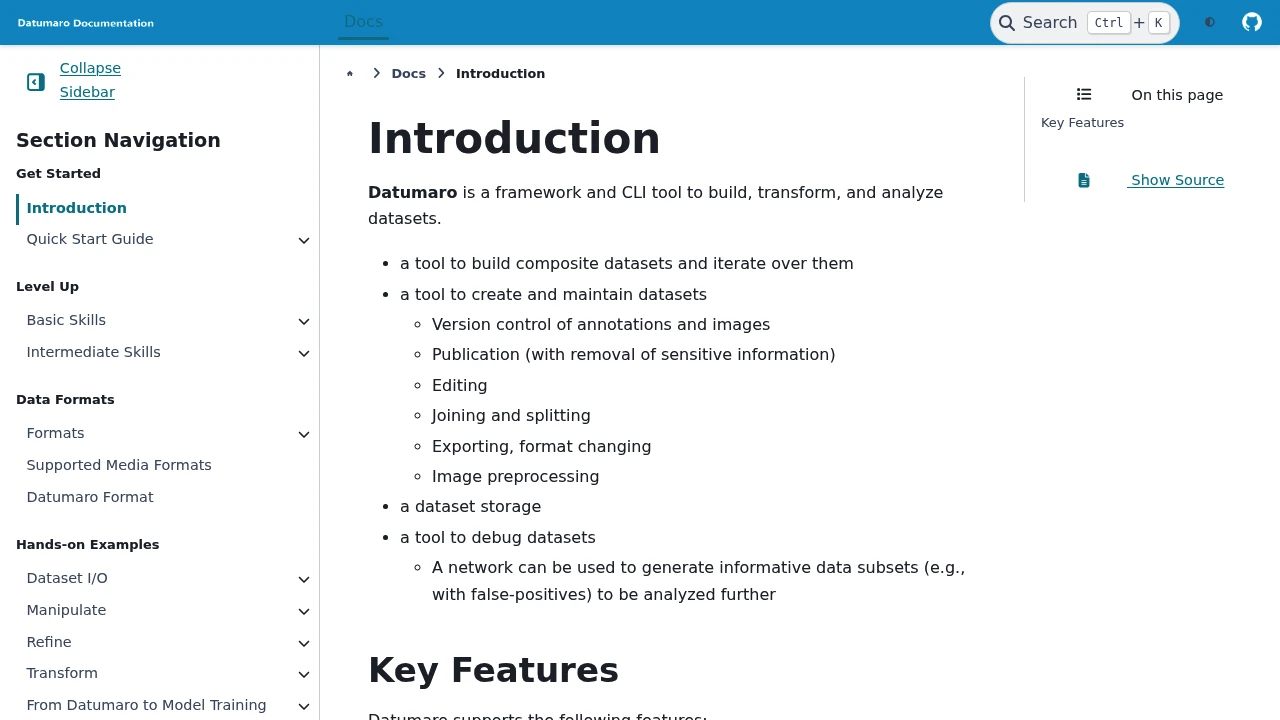
Datumaro is an open-source dataset management framework for computer vision teams that need to move labeled data between annotation, curation, and training workflows. It combines a Python library with a command-line interface for importing, transforming, validating, comparing, and exporting datasets across many widely used vision formats.
What it does
Datumaro is built around dataset operations that often become brittle when teams rely on one-off scripts. The project supports import and export for many public computer vision formats, dataset merging, schema transformation, filtering, task-aware train/validation/test splitting, annotation validation, and dataset statistics.
The same toolkit is used for both command-line automation and Python-based workflows. That makes it useful when a team wants repeatable preprocessing steps in CI, notebooks, or internal data pipelines instead of format-specific conversion scripts.
Where it fits
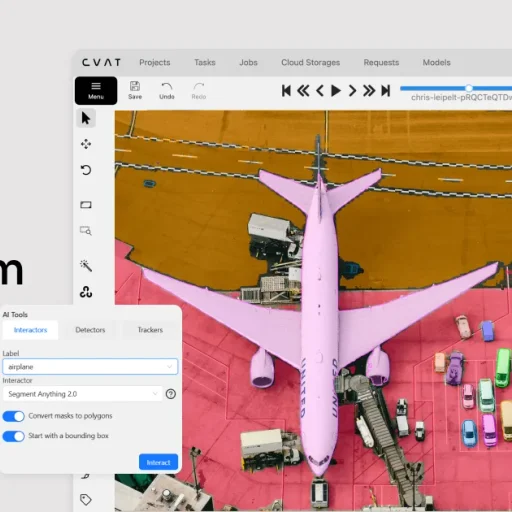
Datumaro fits between annotation tools and model training stacks. Official documentation positions it as the native dataset framework behind CVAT's Datumaro format and as part of the broader OpenVINO ecosystem for data preparation.
For industrial AI teams, that makes it relevant when datasets need to be normalized across vendors, labeling tools, or model targets before defect detection, visual inspection, or other computer vision training work begins.
Why teams use it
The main value is format interoperability plus dataset hygiene in one toolchain. Instead of maintaining separate utilities for conversion, filtering, comparison, and split generation, teams can keep those operations in a single framework with documented CLI commands and Python APIs.
Datumaro is also useful for reviewing dataset quality before training. Its validation, comparison, and statistics features help teams catch label inconsistencies, bad subsets, or schema mismatches earlier in the pipeline.
Limitations
- Datumaro is focused on dataset transformation and analysis, not annotation UI, so teams still need a separate labeling product such as CVAT or another annotation workspace.
- The project is specialized for computer vision data formats rather than general ML data engineering, so it is less suitable for tabular, text, or multimodal pipelines outside image- and video-centric workflows.
- Many advanced workflows assume comfort with Python packages or CLI automation, which is a higher operational bar than browser-only annotation platforms.
- Format support is broad, but teams still need to verify task-specific fidelity when moving complex annotations between source and target schemas because not every format represents labels, attributes, or structures in the same way.

Similar to Datumaro