CVAT
Open-source data annotation platform for computer vision datasets. CVAT supports image, video, and 3D labeling workflows, team review, REST API automation, and self-hosted or managed deployment.
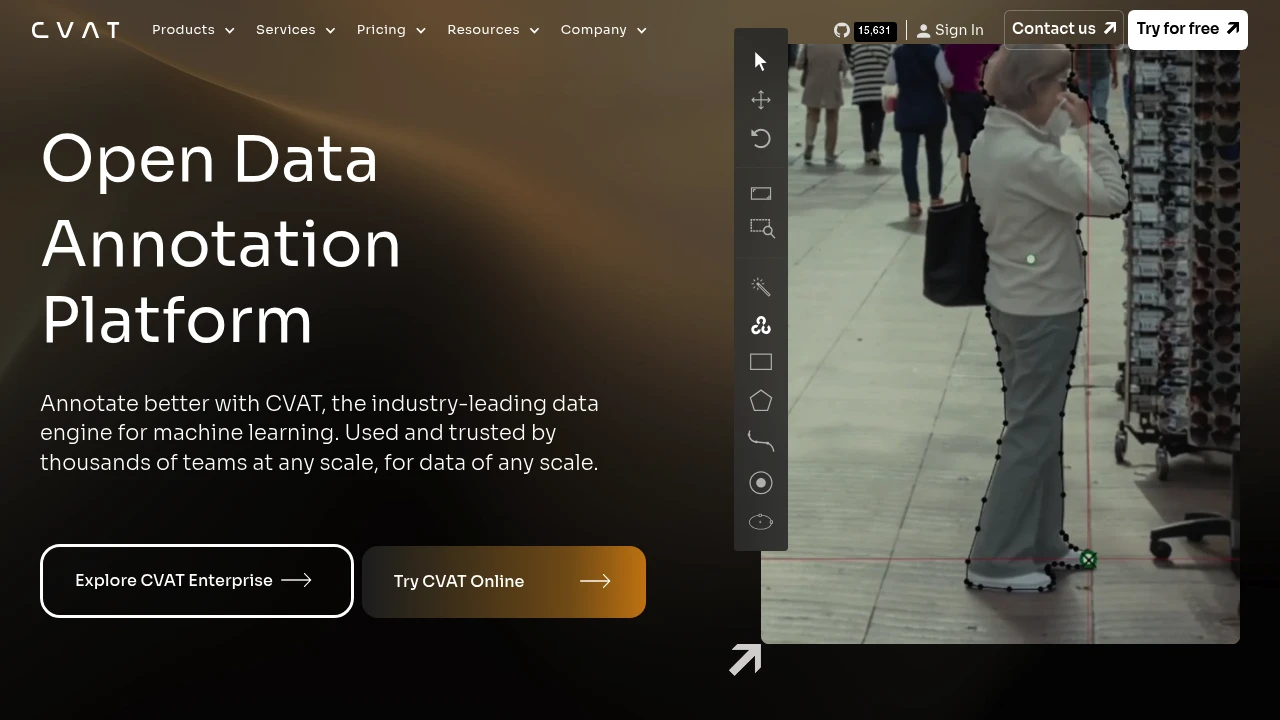
CVAT is an open-source data annotation platform for building and maintaining computer vision datasets. Teams use it to label images, videos, point clouds, and 3D cuboids, then export annotations into common training formats or automate workflows through its API, SDK, and CLI.
What it does
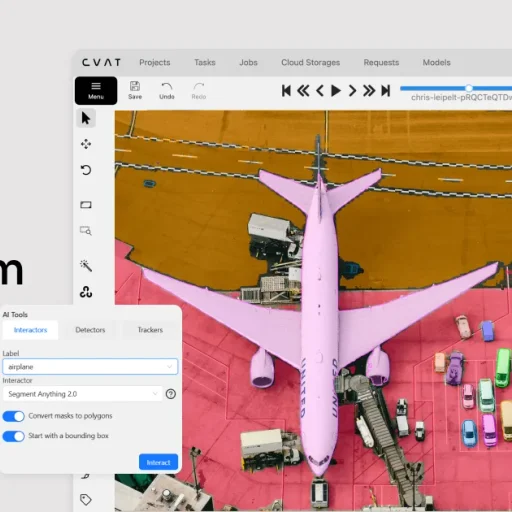
CVAT covers common visual labeling workflows including image classification, object detection, segmentation, skeletons, video tracking, and point-cloud annotation. The platform supports manual labeling, review workflows, quality control features, cloud storage connections, and serverless auto-annotation with external models.
How teams use it
CVAT fits teams that want one annotation workspace for both ad hoc labeling and repeatable dataset operations. The documentation highlights REST API access, Python SDK and CLI tooling, native CVAT import/export, and integrations such as FiftyOne for programmatic dataset workflows.
For manufacturing and industrial AI work, CVAT is relevant when teams need to create defect-detection, worker-safety, automotive, or robotics datasets from camera and LiDAR footage. Its support for on-premise deployment also makes it usable in environments where raw visual data cannot leave a private network.
Why it stands out
CVAT supports a broad set of annotation shapes and task types in one interface, including boxes, polygons, masks, skeletons, cuboids, and tracks. The project also supports many exchange formats through its native exporters and Datumaro-based dataset tooling, which helps teams move data into downstream training pipelines without building a custom labeling stack first.
Limitations
- Self-hosting is more involved than lightweight labeling tools because CVAT uses a multi-service deployment with Docker images and optional infrastructure for cloud storage, analytics, and serverless auto-annotation.
- Advanced auto-labeling workflows depend on external model runtimes and serverless functions such as OpenVINO-, ONNX-, TensorFlow-, or PyTorch-based integrations rather than a single built-in model stack.
- CVAT is focused on annotation operations, not end-to-end model training or experiment tracking, so teams still need separate tools for dataset curation, training, and ML lifecycle management.
- The SaaS plan includes usage and feature limits, while some enterprise controls such as private hosting, SSO, and expanded governance are positioned in the commercial offering.
CVAT OpenVINO
CVAT supports serverless auto-annotation functions based on OpenVINO models, allowing teams to run assisted labeling workflows from the annotation interface. This makes OpenVINO a practical inference backend for CVAT deployments that want CPU-optimized automatic labeling on Intel hardware.
CVAT FiftyOne
CVAT supports a FiftyOne integration that lets teams programmatically create CVAT tasks and jobs, upload data, define label schemas, and download annotations from FiftyOne. CVAT documentation describes the integration surface for driving annotation operations from FiftyOne Python APIs.
Similar to CVAT