FiftyOne
Open-source computer vision data curation and model evaluation platform. It helps teams inspect multimodal datasets, manage annotation workflows, and analyze model behavior through a Python-native interface and visual app.
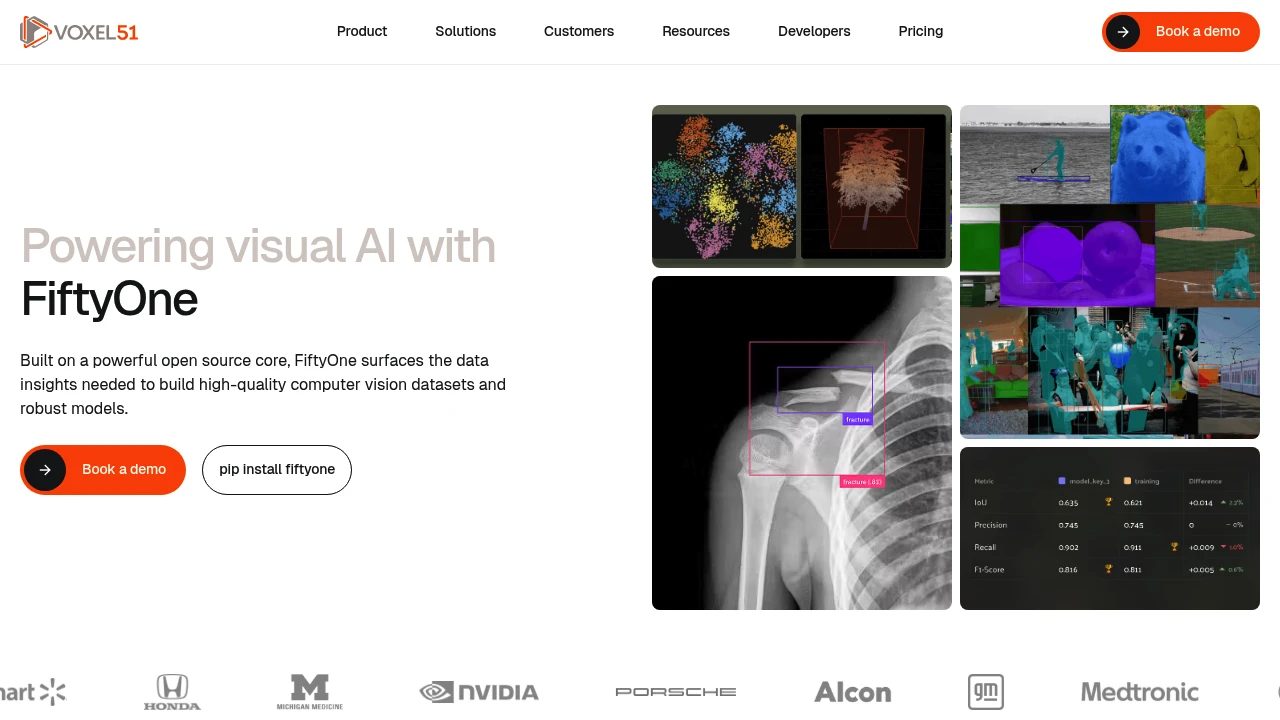
FiftyOne is an open-source platform for building, inspecting, and improving computer vision and multimodal AI datasets. It combines a Python SDK with a visual application so teams can explore samples, review labels and predictions, run evaluations, and iterate on dataset quality without stitching together separate inspection and curation tools.
What it does
FiftyOne is built around data-centric computer vision workflows. Users can load image, video, and 3D datasets, launch an interactive app, filter and slice subsets, inspect embeddings, compare predictions against ground truth, and trace failure cases back to specific samples or labels. The project also includes dataset and model zoo integrations, plugin extensibility, and documented connections to annotation backends such as CVAT, Label Studio, V7, and Labelbox.
How teams use it
Teams commonly use FiftyOne between model training and annotation operations. A researcher or ML engineer can curate data locally in Python, launch the app for visual review, identify outliers or mislabeled samples, send subsets to an annotation backend, and then import revised annotations back into the dataset for another evaluation loop. Voxel51 also offers enterprise deployment for larger collaborative and cloud-native workloads, but the open-source core is the primary entry point.
Deployment and ecosystem
The open-source project installs from pip and supports Python 3.9 through 3.12. Documentation and README material also describe Docker-based environments, local launches through the FiftyOne app, integrations with frameworks such as PyTorch and TensorFlow, and vector-search integrations including Redis and Qdrant. For manufacturing and robotics teams working with inspection cameras, warehouse video, or autonomy datasets, FiftyOne is best understood as a visual AI workflow layer rather than a factory-specific application.
Limitations
- The open-source core is centered on Python workflows, so teams without Python-based data pipelines will face more integration work than with browser-first annotation platforms
- Large image, video, and 3D datasets can demand substantial local compute, storage, and indexing resources, especially when embeddings or similarity search are enabled
- Annotation itself is not limited to the built-in experience; many production teams still rely on external backends such as CVAT, Label Studio, V7, or Labelbox for broader labeling operations
- Collaboration, governance, and large-scale cloud deployment capabilities are stronger in FiftyOne Enterprise than in the open-source edition
- Production use often depends on adjacent infrastructure such as MongoDB configuration, Docker environments, or external vector databases rather than a single self-contained binary
FiftyOne TensorFlow
FiftyOne integrates with TensorFlow-based workflows by supporting dataset inspection, prediction review, and model evaluation around TensorFlow models in Python. FiftyOne documentation and README describe TensorFlow as part of the framework ecosystem it works with.
FiftyOne PyTorch
FiftyOne integrates with PyTorch-based workflows by letting teams load datasets, inspect predictions, review failure cases, and analyze embeddings around PyTorch models from Python. FiftyOne documentation and README explicitly position PyTorch as part of its supported deep learning ecosystem.

Similar to FiftyOne