ContextForge
Open-source gateway and registry for MCP servers, A2A agents, and REST or gRPC APIs. It centralizes discovery, auth, routing, and observability for agent tool access across local, container, and Kubernetes deployments.
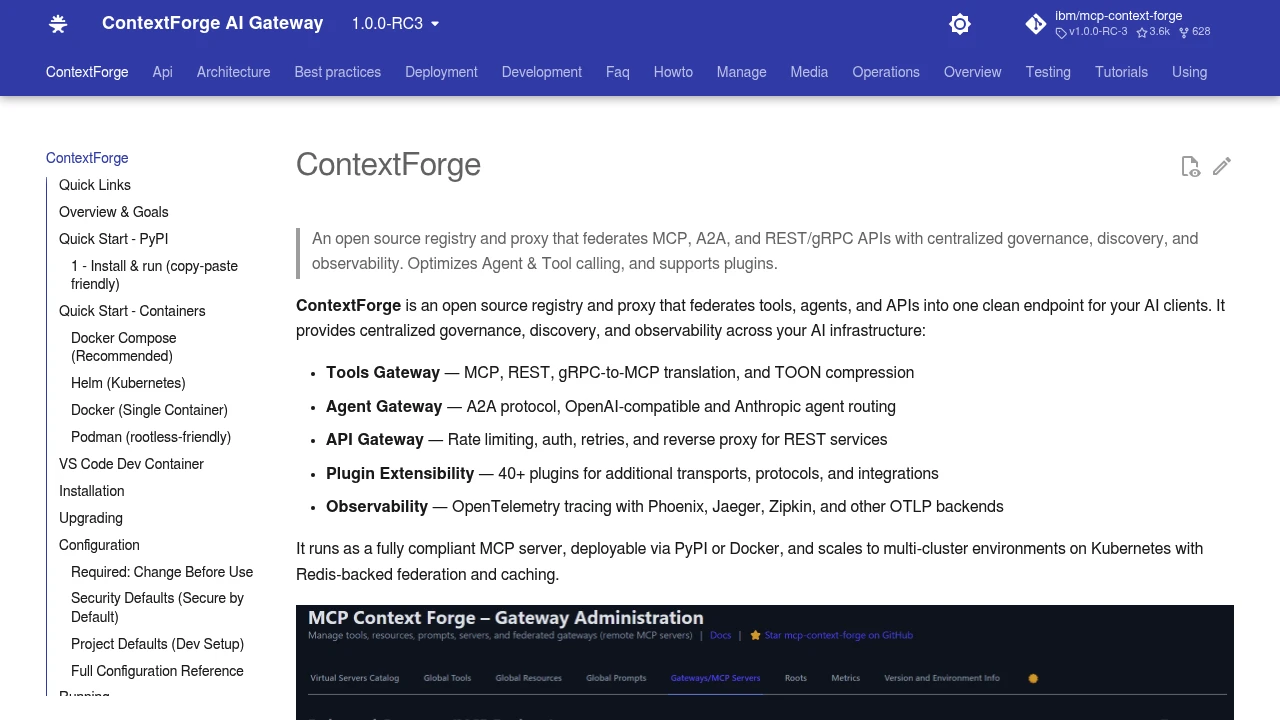
ContextForge is an open-source gateway layer for teams that need to expose MCP servers, A2A agents, and conventional APIs behind one governed endpoint. IBM positions it as a registry, proxy, and control plane for agent tooling, with features for protocol translation, centralized auth, rate limiting, observability, and multi-environment deployment.
What it does
ContextForge federates MCP servers, wraps REST and gRPC services as MCP-compatible tools, and routes agent traffic through a single control point. The project also includes an admin UI, OpenTelemetry support, plugin extensibility, and deployment paths ranging from local Python installs to Docker Compose and Kubernetes.
Where it fits
The tool fits teams building internal agent platforms, MCP catalogs, or managed tool gateways that need stronger governance than direct point-to-point client connections. Its documentation emphasizes multi-cluster operation, Redis-backed federation, JWT-based access control, and support for OpenAI-compatible, Anthropic, and A2A agent routing patterns.
Key strengths
- Unifies MCP, A2A, REST, and gRPC backends behind one registry and proxy layer
- Supports multiple transports including HTTP, WebSocket, SSE, stdio, and streamable HTTP
- Includes built-in admin UI, health checks, and OpenTelemetry tracing integrations
- Offers Docker, Compose, Helm, and Kubernetes deployment paths for self-hosted environments
Limitations
- Production setup is infrastructure-heavy compared with a single-purpose MCP wrapper because it introduces auth, databases, and optional Redis components
- The public docs emphasize self-hosting and technical configuration, so non-engineering teams may face a steeper onboarding curve than with hosted SaaS gateways
- Screenshot automation was unavailable during this draft session, so the listing still needs a verified product screenshot before review or publication
- The ecosystem is evolving quickly, which means transport support, plugin counts, and operational guidance can change faster than static directory content
- Some ontology metadata is still incomplete for newly added topics such as stdio and should be reviewed before publication
ContextForgeContextForge and Microsoft MCP Gateway both sit between MCP clients and backend tools, but they come from different operating assumptions. ContextForge is an open-source self-hosted registry and proxy for MCP, A2A, REST, and gRPC federation, while Microsoft MCP Gateway is aligned with the Microsoft ecosystem and enterprise gateway workflows.
ContextForgeContextForge and MetaMCP are both MCP federation gateways. ContextForge is IBM's Apache 2.0 platform with Cedar-based RBAC, 40+ plugins, and a heavier operational footprint; MetaMCP is MIT with a simpler Servers-Namespaces-Endpoints model and lighter deployment.
ContextForge agentgateway
ContextForge and agentgateway both target MCP traffic but differ in scope. ContextForge is IBM's Python-based AI gateway with an admin UI, Cedar ABAC, plugin ecosystem, and federation across MCP, A2A, REST, and gRPC. agentgateway is a Rust-based Linux Foundation project focused on high-throughput policy enforcement via Envoy-style filters, configured declaratively through the Kubernetes Gateway API.
- Kind
- Software
- License
- Open Source
- Website
- ibm.github.io ↗

Similar to ContextForge