Salesforce
Enterprise customer relationship management platform for sales, service, marketing, analytics, and partner workflows. Salesforce combines configurable business apps, AppExchange extensions, and APIs for customer operations across large organizations.
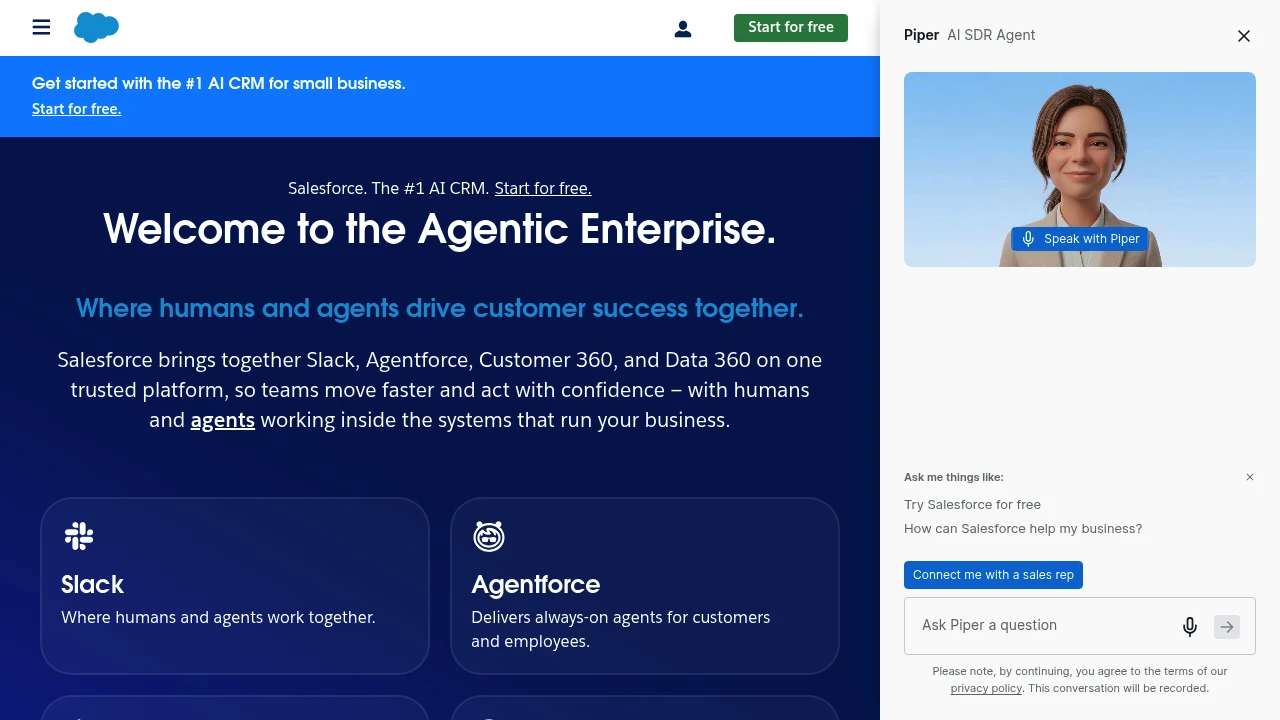
Salesforce is a general-purpose cloud CRM and customer operations platform used for sales, service, marketing, partner management, and workflow automation. In manufacturing and other business environments, it is commonly used to manage accounts, opportunities, service cases, channel relationships, and connected processes that span customer-facing and back-office teams.
What it does
Salesforce provides a configurable data model, workflow automation, reporting, AI-assisted features, and a large ecosystem of add-ons through AppExchange. Its core products cover sales automation, customer service, marketing, analytics, and industry-specific extensions, while its platform tools let teams build custom objects, approval flows, dashboards, and integrations.
How teams use it
Organizations typically use Salesforce as the system of record for leads, accounts, opportunities, quotes, service cases, and partner activity. Large teams often connect it to ERP, support, analytics, document, and integration platforms so that commercial and service processes share the same customer and revenue context.
In manufacturing contexts, Salesforce also appears in account planning, channel sales, aftermarket service, and demand collaboration workflows. Salesforce's Manufacturing Cloud developer surface indicates official APIs for manufacturing-specific integration scenarios, while AppExchange expands the platform with packaged partner applications and consulting solutions.
Integration model
Salesforce is designed to be extended rather than used in isolation. REST APIs, marketplace extensions, and middleware connections are central to how customers deploy it. This matters for manufacturers and enterprise operators because Salesforce often sits alongside ERP, analytics, document management, and customer support tools rather than replacing every adjacent system.
Limitations
- Salesforce is a broad enterprise platform, so implementation usually requires significant configuration, data modeling, and governance rather than a quick out-of-the-box rollout.
- Pricing and packaging can become expensive as organizations add product clouds, automation, analytics, partner tools, and large user counts.
- Many advanced workflows depend on external integrators, internal admins, or middleware to connect Salesforce cleanly with ERP, PLM, finance, or plant-facing systems.
SalesforceSalesforce and HubSpot CRM overlap across sales, marketing, and service workflows, with Salesforce typically aimed at deeper enterprise customization and HubSpot often favored for faster adoption and inbound-focused teams.
SalesforceSalesforce and Microsoft Dynamics 365 both target enterprise CRM and customer operations use cases, but they differ in ecosystem fit, deployment posture, and adjacent product strengths.
Similar to Salesforce