One API
Open-source LLM gateway from songquanpeng that proxies 30+ providers behind an OpenAI-compatible API with built-in user accounts, token wallets, and hard quota enforcement. MIT-licensed with active feature development continuing in the new-api fork.
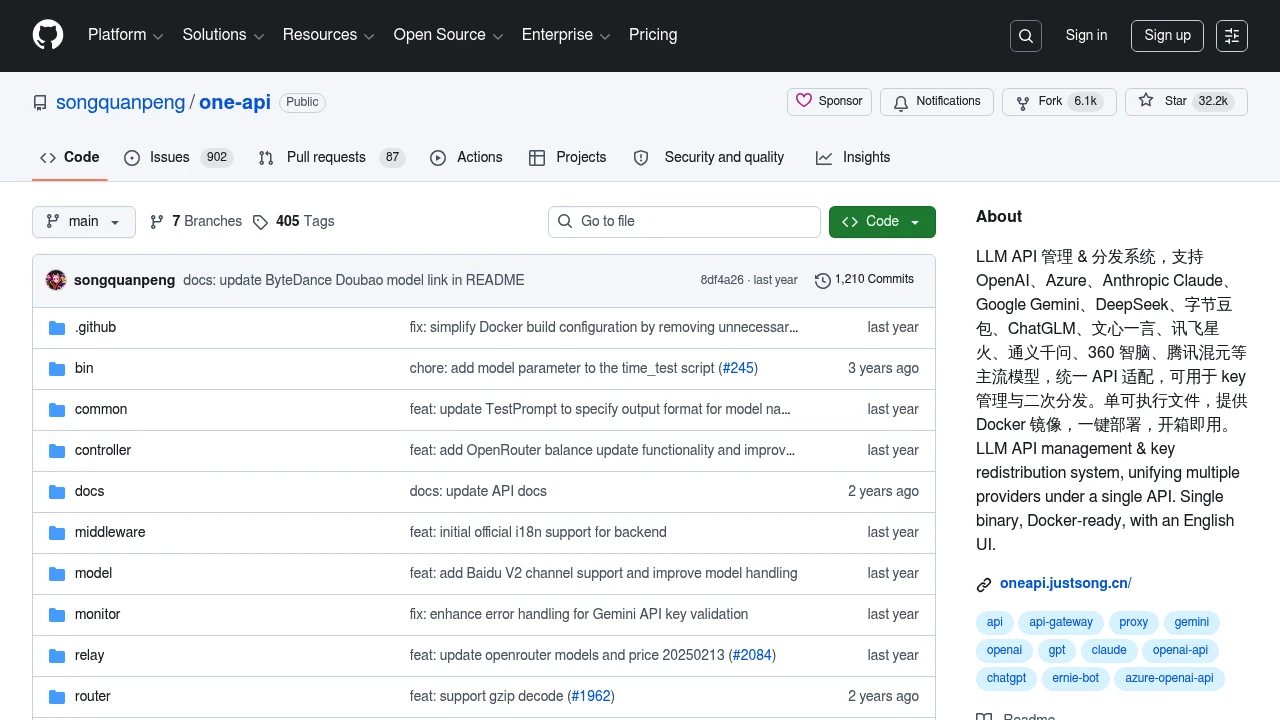
One API is an open-source LLM gateway originally developed by songquanpeng that proxies dozens of LLM providers behind a single OpenAI-compatible API. It includes built-in user management, token-based quota enforcement, and a multi-tenant admin UI, functioning as a self-hostable OpenAI-compatible service with user accounts and per-user billing built in.
What it does
One API routes requests across 30+ providers — OpenAI, Anthropic, Google, Baidu, Alibaba, Tencent, iFlytek, Moonshot, Zhipu, DeepSeek, Ollama, and OpenAI-compatible endpoints — and translates each request into the upstream's native format. Operators configure channels for each provider (an upstream API key plus routing weight), and the gateway distributes requests across channels with weighted load balancing and failover.
End users get accounts with email verification, password reset, and token-denominated wallets. Each request deducts tokens at configurable per-model rates; the API layer rejects requests once the wallet runs out. The admin UI surfaces usage logs and statistics per user, channel, model, and time range.
Licensing
MIT. The full feature set is in the open-source repo with no paid tier. The upstream project is currently in slower maintenance, with active feature development happening in forks — QuantumNous's new-api is the most active of these.
Deployment
Single Docker container plus MySQL or SQLite. Documentation is Chinese-first with community English translations.
Limitations
- No MCP gateway — LLM proxy with billing only.
- No generic OIDC for the admin UI; the built-in user system is the auth model. IdP integration requires fronting the admin UI with a reverse-proxy auth middleware.
- Admin UI and wallet concepts are oriented toward multi-tenant API provider use cases, including account top-ups and invite-based referrals; internal teams often use the wallet as a simple per-employee monthly quota and ignore the resale features.
- English documentation depth varies; advanced configuration sometimes requires reading Chinese-language docs or source code.
- Upstream release cadence is slower than active forks — teams relying on ongoing feature work often adopt a fork (new-api) instead.
Similar to One API