Nuclio
Open-source serverless platform for event-driven function execution on Docker and Kubernetes. Nuclio packages code into containerized functions and exposes them through HTTP, cron, and stream-based triggers.
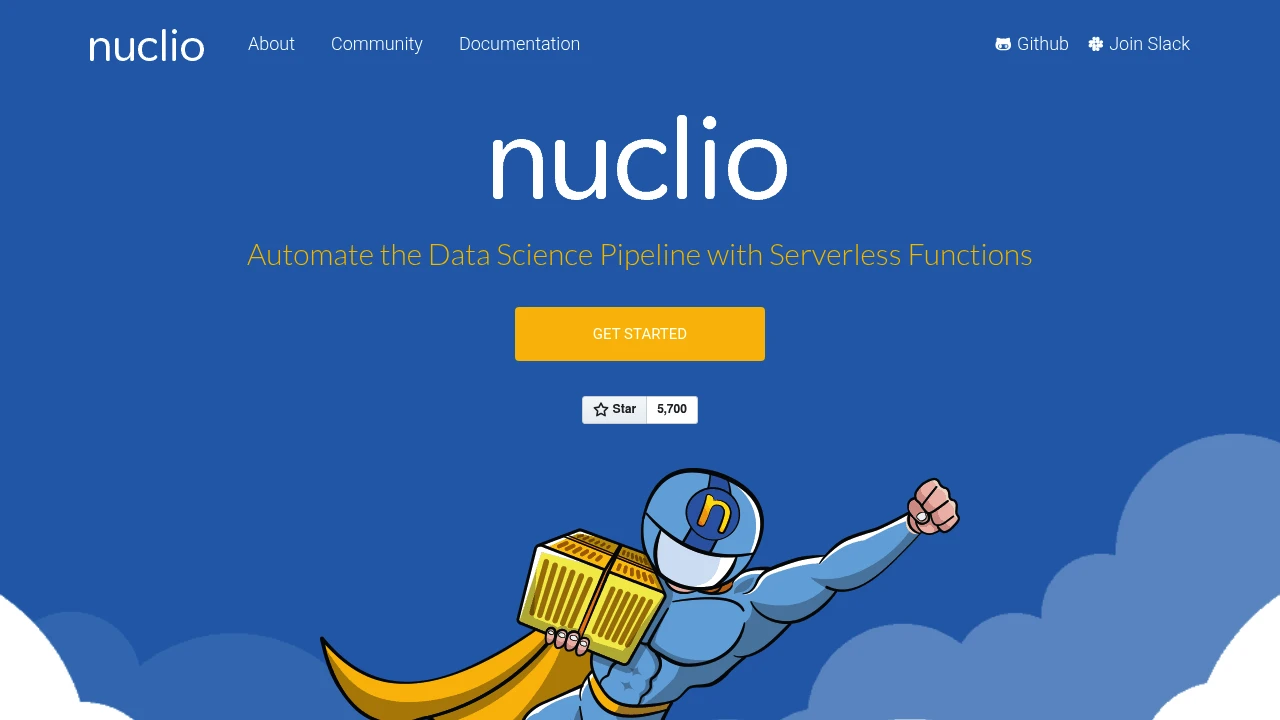
Nuclio is an open-source serverless platform for building and running event-driven functions as containerized workloads. It is designed for teams that need low-latency processing for HTTP requests, streams, scheduled jobs, or data-science inference workloads without wiring each function directly to infrastructure primitives.
What it does
Nuclio lets developers define a handler, package it into a container image, and deploy it with configuration for triggers, runtime, scaling, and environment settings. The platform includes a dashboard, CLI, controller, and processor runtime so teams can manage functions on standalone Docker hosts or Kubernetes clusters.
How it fits in a stack
Nuclio sits between application code and the underlying container platform. A function can be invoked through HTTP, cron schedules, or streaming and messaging sources such as Kafka, while the controller and processor handle deployment, trigger wiring, lifecycle management, and runtime execution.
For industrial and operational systems, that makes Nuclio relevant when a team needs lightweight event handlers for edge gateways, stream enrichment, model-serving endpoints, or automation tasks that react to plant or business events. It is infrastructure software rather than a full low-code integration suite, so it fits best with teams already comfortable operating Docker registries, Kubernetes resources, and function configuration files.
Deployment and operations
Nuclio can run as a standalone Docker-based setup or on top of an existing Kubernetes cluster. Functions are built into container images, pushed to a registry, and then deployed through Nuclio's control plane. On Kubernetes, Nuclio uses its own custom resource and controller pattern to translate function definitions into native cluster resources.
The platform supports multiple runtimes and exposes functions through configurable triggers. HTTP is the default trigger, and the docs describe additional trigger-based operation for cron and stream-oriented sources. The Python runtime docs also show how runtime behavior, handlers, build images, and worker settings are configured per function.
Where it is strongest
Nuclio is strongest when fast event processing matters and the team wants a self-hosted serverless layer rather than a managed cloud FaaS. Its architecture is oriented around high-throughput processors, trigger abstractions, and deployment portability across local Docker, Kubernetes, and edge-oriented environments.
It is also a reasonable fit alongside ML infrastructure. The project documentation explicitly positions Nuclio as integrated with Jupyter, Kubeflow, and MLRun, making it useful when event-driven model serving or data-processing functions need to live near existing machine-learning workflows.
Limitations
- Nuclio is not a zero-ops hosted service. Production use requires container-image builds, a registry, and either Docker host management or Kubernetes operations knowledge.
- Scaling from zero depends on the separate Scaler service, so cold-start handling is not fully self-contained inside the function runtime.
- The default HTTP trigger returns a 503 when no worker is available, which means concurrency and worker sizing need deliberate tuning for bursty traffic.
- Python functions do not support concurrent request handling within a single worker, so higher concurrency requires additional workers or more function instances.
- Exposing functions outside the cluster has explicit security implications in the docs and requires ingress or nodePort configuration plus external authentication and network controls.
- Kind
- Platform
- License
- Open Source
- Website
- nuclio.io ↗

Similar to Nuclio