
Lasso Gateway
Open-source MCP gateway for routing and governing Model Context Protocol servers. It proxies configured MCP servers, applies security plugins to requests and responses, and can scan server reputation before loading them.
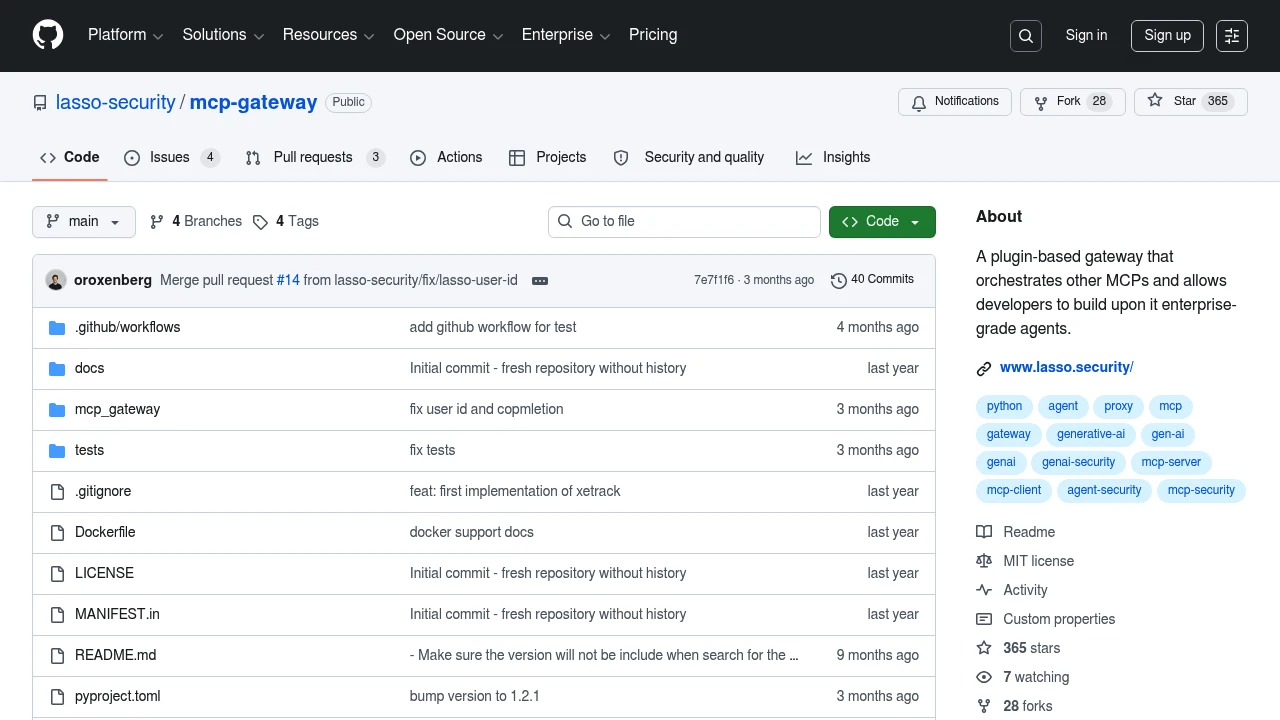
Lasso Gateway is an open-source gateway for Model Context Protocol servers that sits between an AI client and one or more underlying MCP servers. It centralizes server configuration, proxies tool execution through a single interface, and adds optional security and observability plugins around MCP traffic.
What it does
The gateway reads MCP server definitions from an MCP client configuration file, starts and manages those servers, and exposes a unified layer for discovery and execution. Instead of pointing a client directly at each MCP server, teams can route calls through Lasso Gateway to add token masking, PII detection, tracing, or vendor-backed guardrails.
How it is deployed
Lasso Gateway can be installed as a Python package or run from a Docker image. The project documentation shows local configurations for Cursor and Claude Desktop, with optional extras for plugins such as Presidio and Xetrack. This makes it suitable for developer workstations, test environments, and self-managed gateway deployments.
Security and observability model
Built-in plugins cover several different use cases. The basic plugin masks common secrets, the Presidio integration adds PII detection and anonymization, the Lasso plugin sends content to Lasso Security for broader guardrail enforcement, and the Xetrack plugin records tool-call activity for debugging and monitoring. The scanner mode also evaluates configured MCP servers before loading them by combining reputation checks with tool description analysis.
Limitations
- The most advanced guardrail features depend on a Lasso API key and an external Lasso Security service, so they are not fully self-contained in offline environments.
- Plugin coverage is still narrow compared with broader API gateway ecosystems, with the current documentation centered on basic masking, Presidio, Lasso, and Xetrack.
- The project is beta-stage software with a small contributor base, so teams adopting it in production should validate upgrade stability and long-term maintenance expectations.
- The gateway focuses on MCP proxying and policy enforcement, not on broader agent orchestration, model routing, or enterprise identity management workflows.
Lasso GatewayLasso Gateway supports an Xetrack plugin for tracing MCP tool calls, logs, and structured event data. The official docs position Xetrack as the monitoring and debugging companion for gateway traffic.
Lasso GatewayLasso Gateway can be installed with the Presidio extra to add PII detection and anonymization to proxied MCP traffic. The official docs list Presidio as an optional plugin for masking sensitive personal data.

Similar to Lasso Gateway