
EMQX
EMQX is a unified MQTT platform that connects, processes, and streams data from millions of IoT devices to cloud, AI, and analytics systems. It supports 100M+ concurrent connections per cluster with sub-millisecond latency.
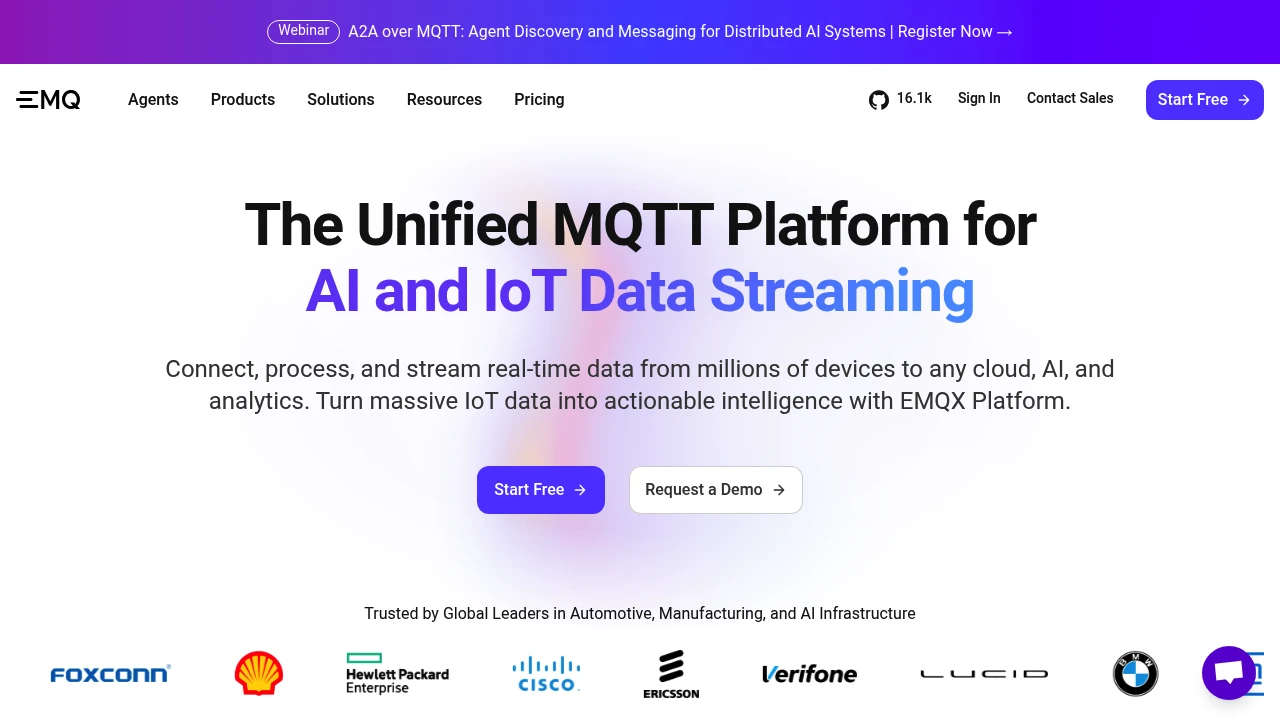
EMQX is a high-performance MQTT broker designed for enterprise IoT and Industrial IoT (IIoT) deployments. Originally launched as an open-source project in 2013, it has evolved into a comprehensive MQTT platform serving over 1,000 enterprise customers and connecting 500M+ devices worldwide.
Key capabilities
Massive scale
- Up to 1.5M connections per node
- 100M+ concurrent MQTT connections per cluster
- Millions of messages per second throughput
- Sub-millisecond message latency
Protocol support
- MQTT 5.0, 3.1.1, and 3.1
- MQTT over QUIC for faster connection establishment
- MQTT over WebSocket for browser clients
- CoAP, LwM2M, STOMP, MQTT-SN via gateways
- NATS bridge support
Data integration
EMQX includes 50+ native integrations across:
- Message Streaming: Kafka, Confluent, Pulsar, RocketMQ, RabbitMQ
- Databases: PostgreSQL, MySQL, MongoDB, Redis, InfluxDB, TimescaleDB, TDengine, ClickHouse
- Cloud: AWS Kinesis, Azure Event Hubs, GCP Pub/Sub
- AI/LLM: OpenAI, Claude, Gemini via Flow Designer
Enterprise features
- SQL-based Rule Engine for in-flight data processing
- Flow Designer for visual data pipelines
- Schema Registry and validation
- Masterless clustering with automatic failover
- RocksDB persistence for message durability
- TLS/mTLS, JWT/OAuth, X.509 certificate authentication
- ACL/RBAC for fine-grained topic access control
Deployment options
| Option | Best For | Pricing |
|---|---|---|
| Serverless | Prototyping, small deployments | Free tier (1,000 conn), then pay-as-you-go |
| Dedicated | Production workloads | From $234/month, 99.99% SLA |
| BYOC | Data residency requirements | Custom pricing |
| Enterprise | Self-managed, air-gapped environments | Custom annual subscription |
Use cases
- Smart Manufacturing: Real-time production line monitoring, predictive maintenance
- Connected Vehicles: Fleet management, OTA updates, telematics
- Energy & Utilities: Smart grid, renewable energy monitoring
- Smart Cities: Traffic management, environmental monitoring
Limitations
- License Change: As of v5.9.0+, EMQX uses BSL 1.1 license; clustering requires a license file
- Complexity: Enterprise features have a learning curve; smaller deployments may be overkill
- Resource Requirements: High connection counts need significant RAM and CPU
- Erlang Expertise: Custom plugins require Erlang/OTP knowledge
Integrates with
EMQX Node-RED
EMQX and Node-RED form a powerful combination for IoT data collection and processing, with EMQX handling high-scale MQTT ingestion and Node-RED providing visual workflow automation.
EMQX Apache Kafka
EMQX provides native Kafka integration through its Rule Engine, enabling seamless streaming of MQTT messages to Kafka topics for real-time processing and analytics.
EMQX InfluxDB
EMQX provides native InfluxDB integration, enabling direct storage of MQTT message data into InfluxDB time-series database for IoT analytics and monitoring.
Competes with
EMQX HiveMQ
EMQX and HiveMQ are both enterprise-grade MQTT brokers competing in the high-scale IoT market. Both offer clustering, cloud options, and enterprise features, but differ in licensing, pricing, and ecosystem.
EMQX VerneMQ
EMQX and VerneMQ are both scalable MQTT brokers with clustering capabilities. VerneMQ emphasizes simplicity and operational ease, while EMQX focuses on extensive integrations and enterprise features.
EMQX Mosquitto
EMQX and Mosquitto are both MQTT brokers but target different use cases. Mosquitto is a lightweight broker ideal for edge devices and small deployments, while EMQX is designed for massive enterprise-scale deployments with millions of connections.
- Kind
- Software
- Vendor
- EMQ
- License
- Proprietary
- Website
- www.emqx.com ↗

Similar to EMQX

