
Zapier
Zapier is a cloud-based no-code automation platform that connects over 8,000 apps via trigger-action workflows ("Zaps"), enabling non-technical users to automate data movement and business processes without writing code.
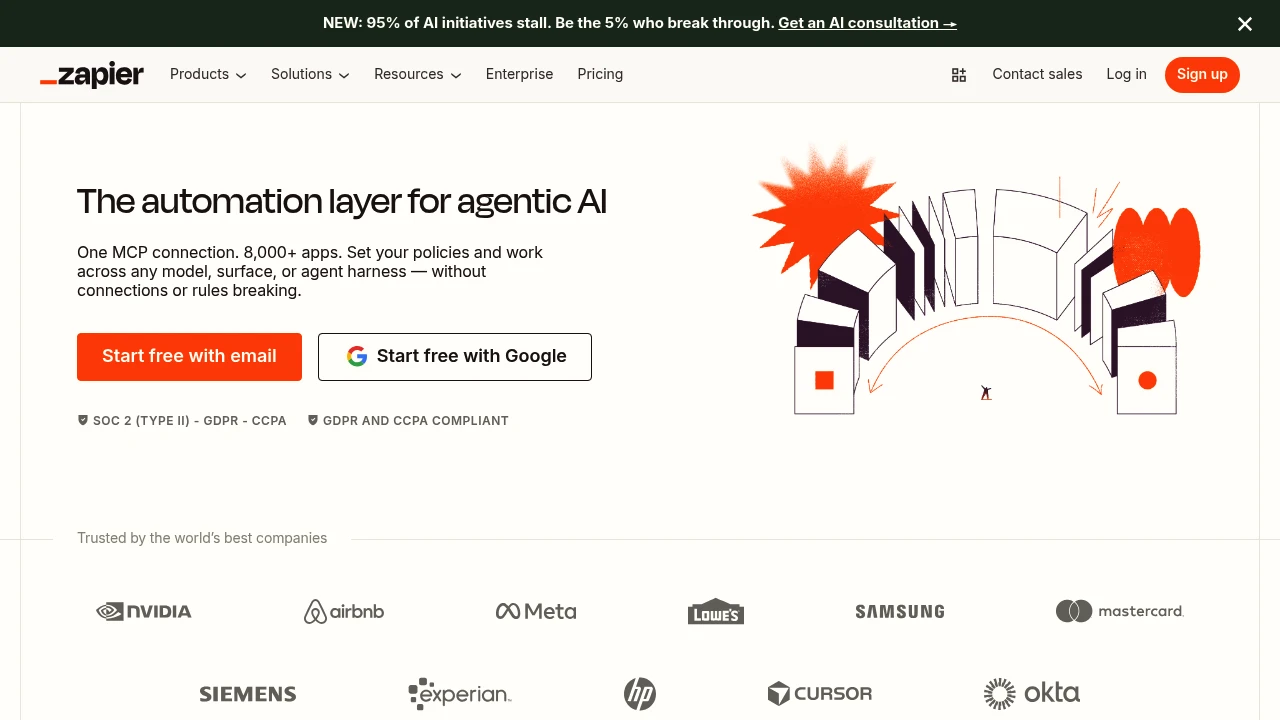
Zapier is a cloud-based no-code integration and automation platform founded in 2011. It lets users build automated workflows — called Zaps — that connect two or more web applications via trigger-action logic. When a trigger event fires in one app (such as a new CRM lead), Zapier automatically executes one or more actions in connected apps (such as adding a row to a spreadsheet or posting a Slack message). The platform supports over 8,000 app integrations, the largest catalog of any general-purpose automation tool. As of 2026, Zapier has expanded beyond simple two-step automations into multi-step workflows with conditional branching, an AI agent builder, an MCP (Model Context Protocol) server for connecting AI models to apps, a no-code database (Tables), and a form builder.
Core capabilities
Zapier workflows are built in a visual no-code editor. Each Zap has one trigger and one or more action steps. Built-in tools — filters, formatters, path branching, delays, and sub-Zaps — do not consume task quota. The platform includes a Copilot assistant that generates Zaps from natural language descriptions.
Zapier MCP exposes the full 8,000-app catalog as a Model Context Protocol server, allowing AI agents and LLM-based tools to call Zapier actions directly. Each MCP tool call consumes two tasks from the account quota.
Zapier Agents provides a separate AI agent runtime where users define behaviors in plain language and the agent executes multi-step tasks autonomously across connected apps. Agents are priced separately by "activity" count rather than tasks.
Pricing model
Zapier uses task-based pricing. A task is counted each time a Zap action executes successfully. Plans range from Free (100 tasks/month, two-step Zaps only) to Professional (from $19.99/month, multi-step Zaps, webhooks) to Team (from $69/month, shared workspaces, SAML SSO) to Enterprise (custom pricing, VPC peering, unlimited users, annual task pools). Annual billing saves 33%. Tasks that exceed a plan's monthly limit incur pay-per-task billing at 1.25× the base rate; Zaps pause when usage reaches 3× the subscribed limit.
Security and compliance
Zapier holds SOC 2 Type II and SOC 3 certifications and is GDPR and CCPA compliant. Enterprise accounts support SAML 2.0 SSO, SCIM automated provisioning, role-based permissions, audit logs, and VPC peering for accessing internal data sources. Uptime SLA is 99.99%.
Limitations
- Cloud-only deployment — no self-hosted or on-premise option exists; all data flows through Zapier's infrastructure
- Task-based billing becomes expensive at scale; high-volume workflows cost significantly more than self-hosted alternatives like n8n
- No native support for industrial protocols (OPC-UA, MQTT, Modbus); factory floor systems require middleware or custom webhooks to connect
- Zap execution is poll-based for most triggers, introducing latency of 1–15 minutes on free/lower plans before an action fires
- Limited data transformation capability compared to purpose-built ETL tools; complex data mapping requires workarounds with Formatter steps
- MCP integration counts two tasks per call, making AI-heavy workflows expensive relative to direct API integrations
- Vendor lock-in risk: Zap configurations are not portable to other platforms; migrating to Make or n8n requires rebuilding all workflows
ZapierMake (formerly Integromat) and Zapier are the two dominant cloud-based no-code workflow automation platforms. Both solve the same problem — connecting SaaS apps via trigger-action workflows without code — and buyers directly substitute one for the other. Make offers a visual scenario builder with more powerful data transformation at roughly one-third the cost per task; Zapier leads on app catalog breadth (8,000+ vs ~1,500) and ease of use.
Zapier n8n
n8nn8n and Zapier both provide workflow automation connecting applications via trigger-action logic. They are direct substitutes: buyers evaluating one routinely shortlist the other. n8n differentiates through self-hosting, fair-code licensing, and per-node pricing with no task caps, making it significantly cheaper at high volume; Zapier leads on app catalog size and non-technical accessibility.
 WorkatoZapier
Workato and Zapier both automate workflows across SaaS applications through low-code trigger-action building, but they target different buyer profiles. Workato is positioned for governed enterprise orchestration and hybrid integration, while Zapier is usually favored for simpler self-serve automation and lower-complexity business workflows.
Similar to Zapier


