PyCaret
Open-source low-code machine learning library for Python. It wraps common training, comparison, tuning, deployment, and drift-check workflows for tabular, time-series, clustering, and anomaly-detection use cases.
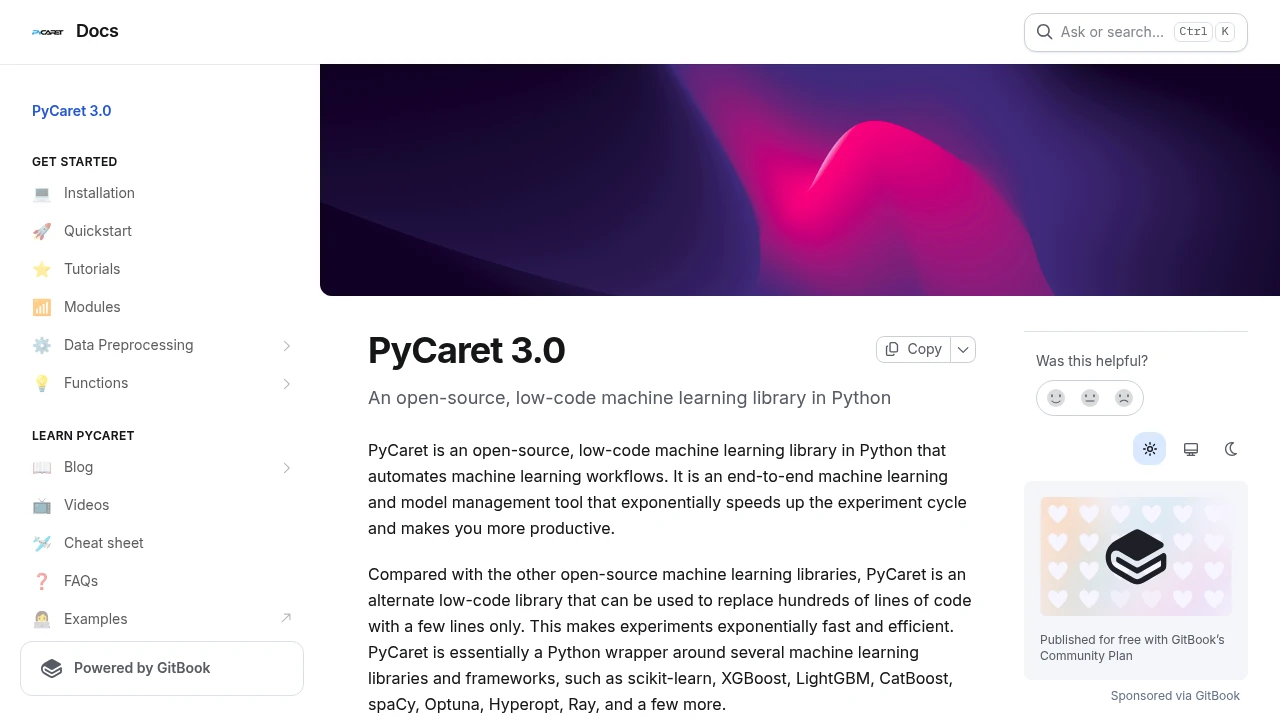
PyCaret is a Python library for running end-to-end machine learning experiments with a smaller surface area than building every preprocessing, model selection, and deployment step by hand. It packages setup, comparison, tuning, evaluation, persistence, drift checks, API generation, and deployment helpers into a workflow that sits above libraries such as scikit-learn.
What it does
PyCaret supports classification, regression, time series, clustering, and anomaly detection workflows. The project exposes both a functional API and experiment classes, and it can save pipelines, save experiments, generate inference APIs, create Docker assets, and deploy model artifacts to cloud object storage.
How teams use it
Data teams often use PyCaret to benchmark many baseline models quickly, standardize notebook-driven experiments, and hand off reproducible pipelines without writing the same preprocessing and evaluation code for every project. Its optional extras also cover analysis, tuning, MLOps, parallel execution, and full installs for broader experimentation environments.
Deployment and integration notes
PyCaret documents helpers for AWS, GCP, and Azure deployment targets, local pickle-based model persistence, API generation for inference, Dockerfile generation, and drift reports using evidently. The project also highlights interoperability with BI tools and Jupyter-based workflows, which makes it approachable for analytics teams that want to add predictive models without adopting a full MLOps platform first.
Limitations
- PyCaret is a wrapper layer, so teams still inherit dependency constraints and version friction from underlying libraries such as scikit-learn, LightGBM, CatBoost, Ray, and other optional components.
- Advanced users who need fine-grained control over estimator internals, custom pipelines, or bespoke training logic may outgrow PyCaret's higher-level abstractions and drop down to lower-level libraries.
- Several production features rely on local file generation, cloud credentials, or optional extras, so deployment is not turnkey unless the surrounding Python environment and cloud access are already prepared.
- The project's recent repository activity is steadier than its last tagged release, which can make version selection and dependency planning more cautious for production teams.
Similar to PyCaret

