
Harvester
Open-source hyperconverged infrastructure software for bare-metal Kubernetes and virtual machine workloads. Harvester combines virtualization, distributed storage, and infrastructure management for datacenter and edge deployments.
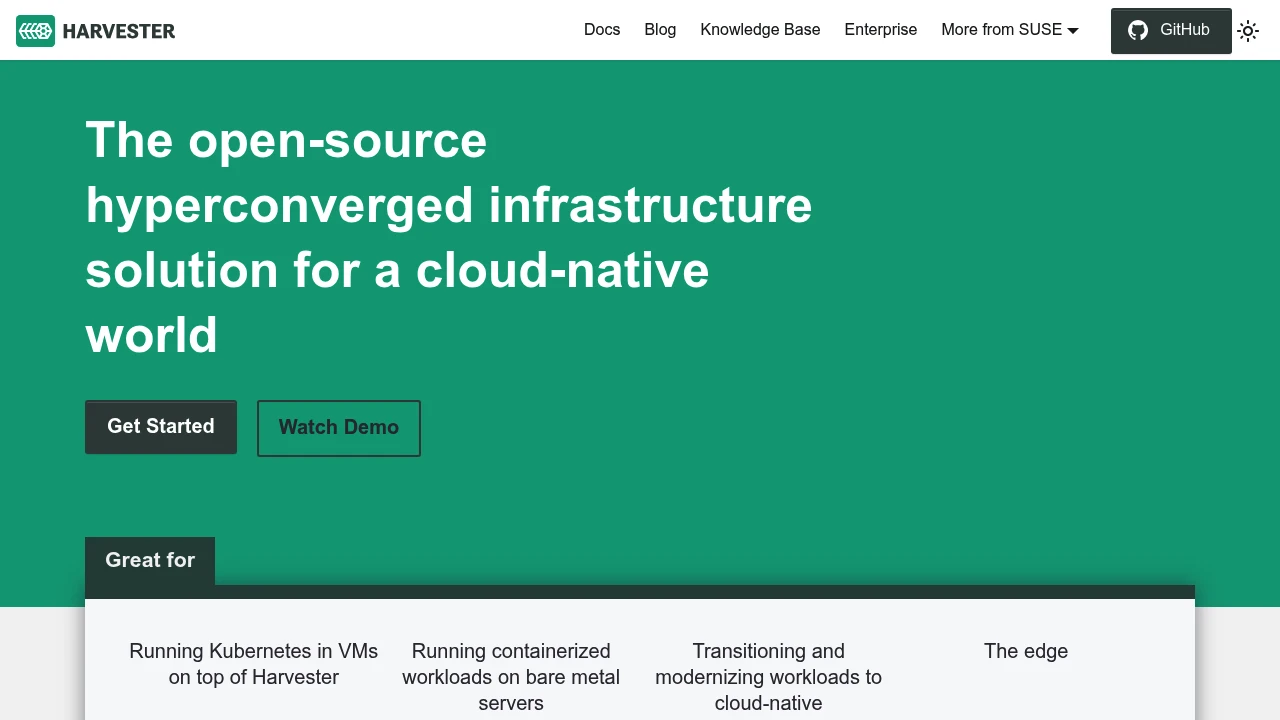
Harvester is an open-source hyperconverged infrastructure platform for operators who want to run virtual machines and Kubernetes-oriented infrastructure on bare metal without adopting a separate proprietary virtualization stack. It packages KVM, Kubernetes, KubeVirt, and Longhorn into a single appliance-style platform with a web UI, cluster management workflows, and built-in distributed storage.
What it does
Harvester installs directly on x86_64 bare-metal servers and forms a cluster for running VM workloads with integrated storage and networking. The platform supports VM lifecycle management, live migration, snapshots, backups, restores, VLAN-aware networking, and multi-node operations from a browser-based interface.
How it fits in a stack
Harvester is positioned as cloud-native HCI rather than a traditional hypervisor product. Its control plane is built on Kubernetes, KubeVirt provides VM orchestration on top of Kubernetes, and Longhorn supplies the distributed block storage layer used for VM disks, snapshots, and related storage operations.
For teams already standardizing on Rancher, Harvester can be imported into Rancher Virtualization Management so VM infrastructure and Kubernetes clusters can be managed side by side. That makes it relevant for operators modernizing existing VM estates while also adopting container platforms across datacenter and edge environments.
Deployment and operations
The project ships as an installable appliance image and supports ISO-based installation and automated iPXE workflows. Documentation highlights support for live migration, SSH key injection, cloud-init, virtual IP management, multiple NICs, VLAN networking, and backup targets such as NFS, S3-compatible storage, and NAS devices.
Harvester is primarily aimed at self-managed environments where teams control the hardware, networking, and cluster lifecycle. The project’s documentation and support material consistently frame it as an option for on-premise and edge infrastructure rather than a hosted SaaS virtualization service.
Limitations
- Harvester runs on bare-metal x86_64 servers and requires hardware-assisted virtualization, so it is not a fit for lightweight hosted trials or ARM-based edge fleets.
- Production guidance is infrastructure-heavy: documentation calls for server-class hardware, at least 64 GB RAM and 500 GB storage per node for production, plus faster networking for live workloads.
- Longhorn is a foundational storage dependency, which means storage behavior, backup patterns, and some operational constraints follow the characteristics and requirements of the Longhorn stack.
- Harvester is designed around Kubernetes-based operations even if the UI hides much of that complexity, so teams may still need Kubernetes-oriented troubleshooting skills for deeper maintenance and integration work.
- The readily available branding assets on the public site are limited, making high-quality logo extraction harder than screenshot capture for directory presentation.

- Kind
- Software
- Vendor
- SUSE
- License
- Open Source
- Website
- harvesterhci.io ↗

More from SUSE
Similar to Harvester

