
Eclipse BaSyx
Eclipse BaSyx implements the Asset Administration Shell standard (IEC 63278), providing the infrastructure layer for creating and managing digital twins of factory assets.
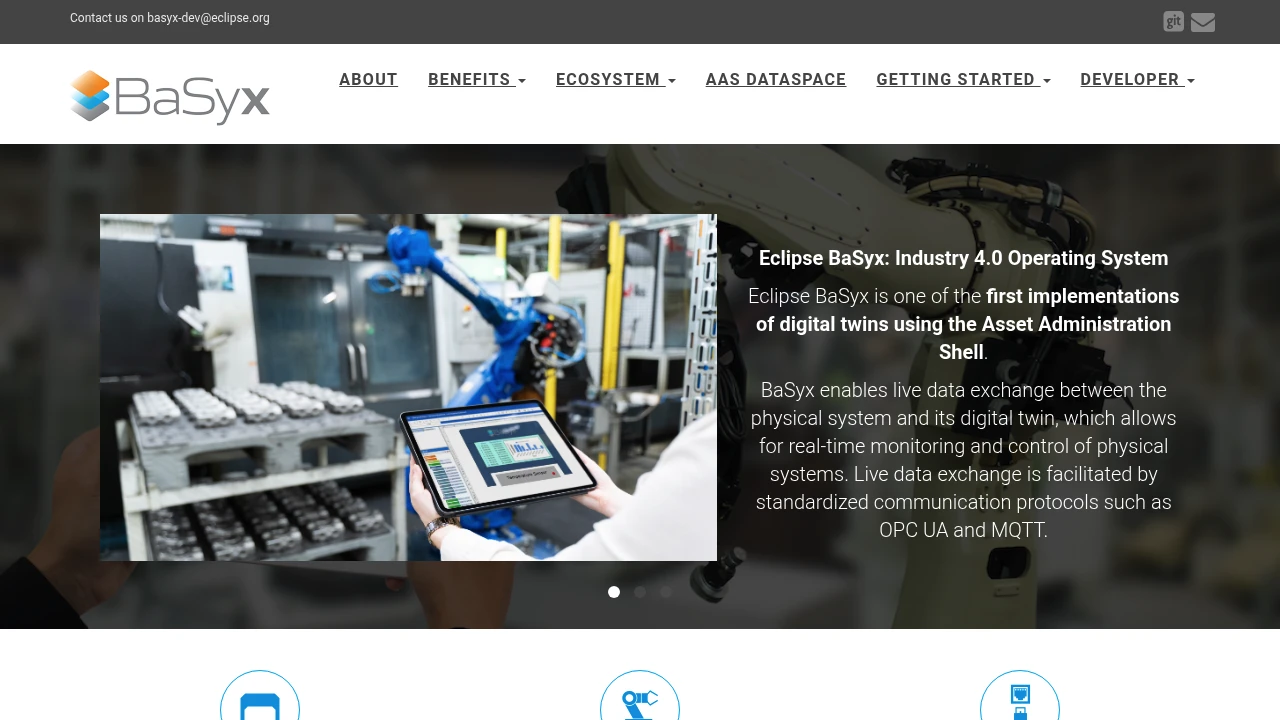
Every machine, sensor, and product in a factory has data scattered across different systems — the PLC holds process parameters, the ERP has the bill of materials, the maintenance log sits in a spreadsheet, and the datasheet is a PDF on someone's laptop. The Asset Administration Shell (AAS) is an industry standard (IEC 63278) that gives each asset a single, structured digital file containing all of this. Think of it as a standardized zip file for everything you'd want to know about a factory asset.
Eclipse BaSyx is the reference implementation, developed by Fraunhofer IESE as part of Germany's Platform Industrie 4.0 initiative. It provides the server infrastructure to host, manage, and query Asset Administration Shells at scale.
Key features
- AAS server and registry — host and discover Asset Administration Shells across your factory network
- Type 1, 2, and 3 AAS support — static documentation, live operational data, and active negotiation between assets
- OPC-UA, MQTT, and HTTP interfaces — connects to existing PLCs, sensors, and IT systems without replacing anything
- Off-the-shelf Docker components, ready to pull from Docker Hub
- Submodel templates for common data structures (nameplate, technical data, maintenance schedules)
- Service-oriented manufacturing — assets export reusable capabilities, enabling flexible production down to lot-size-one
What Eclipse BaSyx does
At the core is an AAS server and registry. The server hosts Asset Administration Shells, each containing typed submodels — everything from static spec sheets to live sensor readings. The registry lets any AAS-aware client discover and query assets across your network, regardless of vendor.
Connecting this to the factory floor, BaSyx provides data provider components that bridge OPC-UA, MQTT, Modbus, and fieldbus protocols into the AAS world. A 20-year-old PLC and a brand-new IoT sensor can both have AAS representations without replacing either one.
On top of this, BaSyx offers basic MES-like functionality through a service-oriented architecture. Assets advertise their manufacturing capabilities, and the system can match product requirements to available services — useful for configure-to-order production and lot-size-one scenarios, though this layer is the least mature in practice.
Why choose Eclipse BaSyx
- Standards-first — the reference implementation of IEC 63278 (AAS), also works with AutomationML (IEC 62714). If you need AAS compliance or interoperability with other AAS-aware systems, this is it
- Fraunhofer-backed — institutional support since 2017, not a startup that might pivot
- MIT licensed — permissive enough to use commercially, modify, and embed in products
- Docker-first deployment with the BaSyx Starter Kit for guided setup
Getting started
- Install Docker
- Use the BaSyx Starter Kit (web tool) — answer questions about your use case, get a generated Docker Compose setup
- Or pull components directly:
docker pull eclipsebasyx/aas-serveranddocker pull eclipsebasyx/aas-registry - Create your first AAS using the Java or Python SDK, or import an existing AASX package file
The quick start guide walks through a complete example with the off-the-shelf Docker components.
Technical specs
- Java server SDK (primary), Python SDK also available
- Docker images on Docker Hub for all components
- MIT license
- 82 stars, 68 forks, 39 contributors on the basyx-java-server-sdk repo; multiple repos under the eclipse-basyx GitHub org
- Active since 2017, part of the Eclipse Foundation digital twin ecosystem
Limitations
- AAS is still a young standard. The tooling ecosystem is small compared to OPC-UA, and APIs are still evolving between releases.
- The GitHub star count (82) understates the project's reach — it has institutional users and Fraunhofer backing, but don't expect a large Stack Overflow community or abundant third-party tutorials.
- Type 3 AAS (active asset negotiation) is the most ambitious part of the vision but also the least mature. Most deployments today stick to type 1 and 2.
- Documentation is thorough but written in an academic style. If you're used to quick-start developer docs, the BaSyx wiki can feel dense.
- If you don't specifically need AAS compliance, simpler approaches may get you to a working digital twin faster — an MQTT broker with a JSON schema, or a Unified Namespace, can solve many of the same problems with less ceremony.
Tags:

- Kind
- Software
- Vendor
- Fraunhofer IESE / Eclipse Foundation
- License
- Open Source
- Website
- eclipse.dev ↗

Similar to Eclipse BaSyx
